Wednesday, September 17, 2014

September 17

Image:  Wikipedia

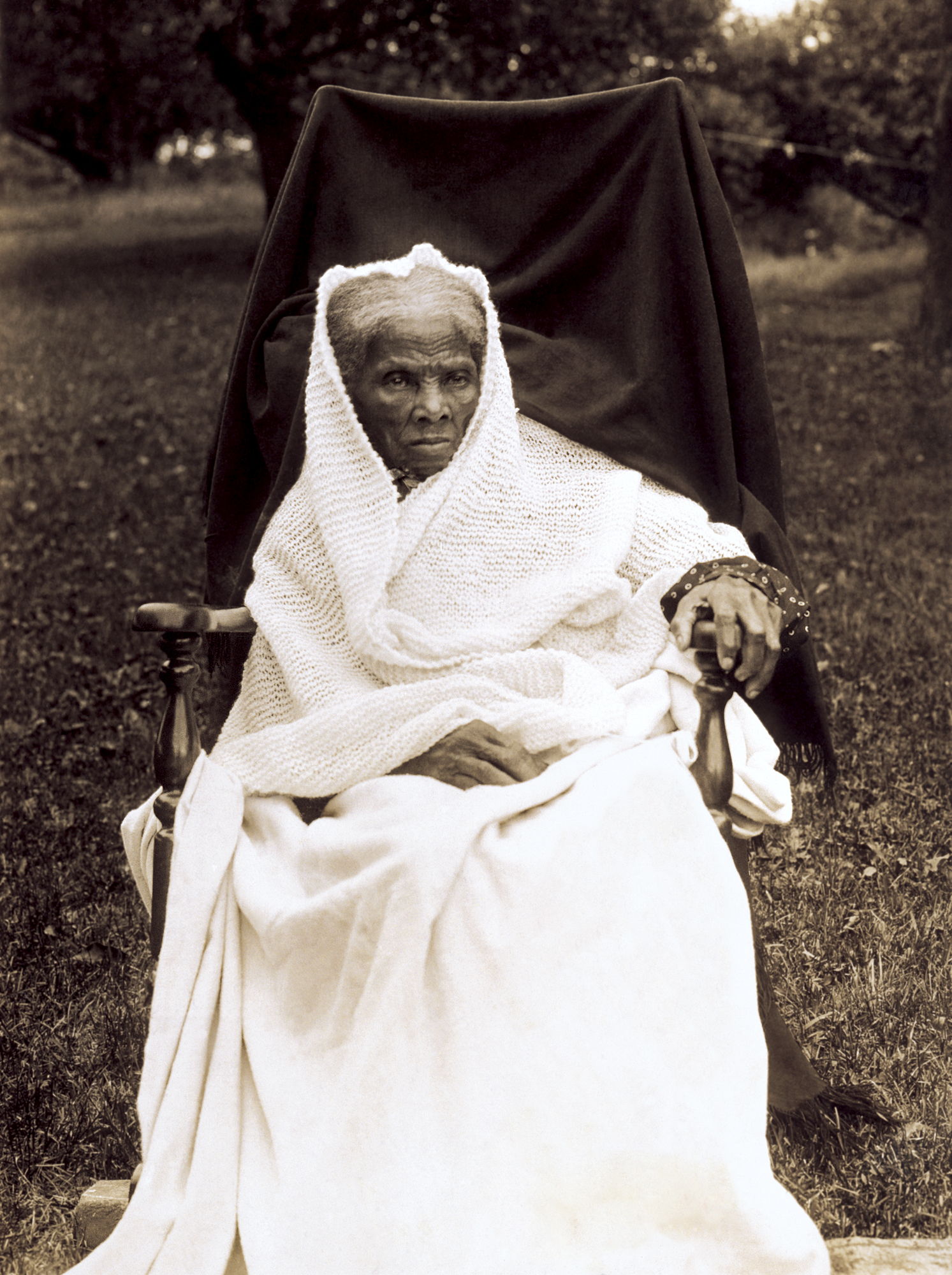
This date was the day, in 1849, when Harriet Tubman escaped slavery and began a journey which freed so many others from inhuman bondage.  She was the builder and the conductor of the Underground Railroad, that route out of the American South that has become legend in our history.  We often romanticize the idea – yet the origin terminus of the Railroad tends to be lost in the telling.  We like the idea of escape from harrowing straits, but history, as it was taught to me anyway, tended to focus on freedom over slavery.  Even when the conditions were considered, it seemed to be from the white point of view – “we were bad” – not really about those who were sinned against.

Yet all my life, even here in the white-flight south, contained threads of truth.  Sojourner Truth, of course.  Maggie Walker, one of the most important figures in the history of finance in the United States, whose name is not enough spoken.  And Harriet Tubman.

Harriet was the figure of excitement, when we were kids.  Sojourner’s spirit may have been beyond our grasp, and Maggie’s accomplishments those of a boring adult.  But Tubman was a real *story* – the story of how my people did wrong, but somebody escaped.  The story of how she helped others to freedom.

Not being an adventure-story seeker, perhaps the tales appealed to me by assuaging some formless seed of White Liberal Guilt, but hers was the figure, of all these Black women, who seemed to mean something to me when I was very young.  Her powerful physical presence, her turban, her manifest *liberty*.  Easier, perhaps, to contemplate her than to imagine than those thousands of others who did not escape, not even with her indomitable struggles.


Harriet Tubman’s mother is said to have stood up to the masters when hers agreed with another to sell her youngest son – and to have succeeded.  Her father was manumitted in 1840, at the death of his master.  She married, before she herself was liberated, a free Black man.  Enchained she was, but freedom was no faraway concept in Maryland in those days.

But Harriet Tubman was enslave, even after she was a married woman, even after she adopted the name of her formidable mother.  She suffered beatings and being loaned away from her family, from that remarkable mother she loved and longed to be with.  From a young age, she was given the hardest work in the field, and endured illness and labor without respite.  She had her skull cracked open for standing up to a white man, and later wrote that it was her hair – her tight and thick hair – which saved her, perhaps, from bleeding to death, from life slipping through the break.

And yet, today, the culture in which we live dares to shame black women for wearing natural hair, even stealing from them the right to make a living.  It sounds, to lift a phrase from those who feel just as free to expend bigotry upon arbitrarily defined periods of time as some feel to wield it against other souls, “positively medieval” to punish, so brutally and in such extraordinary ignorance, someone for the way their hair grows.  For the way they are made – designed, if you will, by the very G-d we have presumed to invoke in defense of the institution of slavery.  Shameful as that was, we are hardly stainless today.

Imagine being wronged and physically injured – reaching to your head and feeling the wound – feeling, even, the bone, no longer whole.  Imagine that you can feel your very HAIR staunching the blood; or knit, perhaps, thick and strong, over two pieces of yourself where once there was one piece.  Imagine feeling that here, like Samson, was the thing that held you to life.


One hundred sixty-five years ago, on this day, one woman escaped for the first time (she was forced back and had to flee again) – and, by her will and her power and her conviction, eventually dozens of others found the liberation she had.  Though not without allies along her way, she was utterly alone in flight, and became a stranger in a strange land.

By the time she had begun the Railroad, white slaveowners presumed some white abolitionist must be siphoning away their slaves – it was unthinkable a Black woman could have succeeded as a leader, taking so many to freedom.  Yet she rescued her own family.  She worked with John Brown and with Susan B. Anthony.  She refused to allow her “passengers” to quail, to quit, to fail, she assisted the Union in the Civil War.  She offered this lesson to President Lincoln:

(T)he negro can tell master Lincoln how to save the money and the young men. He can do it by setting the negro free. Suppose that was an awful big snake down there, on the floor. He bite you. Folks all scared, because you die. You send for a doctor to cut the bite; but the snake, he rolled up there, and while the doctor doing it, he bite you again. The doctor dug out that bite; but while the doctor doing it, the snake, he spring up and bite you again; so he keep doing it, till you kill him. That's what master Lincoln ought to know.

Asked to speak a word of Harriet Tubman for a biography of her, Frederick Douglass said:

The midnight sky and the silent stars have been the witnesses of your devotion to freedom and of your heroism. Excepting John Brown—of sacred memory—I know of no one who has willingly encountered more perils and hardships to serve our enslaved people than you have.


September 17 was the first time she escaped … and, in some way, she spent the rest of her life – escaping, again and again, and bringing with her so many others.  One hundred sixty-five years.  It isn’t all that long a time.

Sunday, September 14, 2014

More on the Not-So-Dirty/Stupid Past

Madame Isis has a marvelously detailed, and SOURCED, piece today on the hygiene of the past.  Regular readers know I have a history here of expressing frustration with the contemporary bigotry against the past as a seething mass of filthy stupidity, miraculously evolving into Bright and Shining Us, we who are today so wise, so enlightened, and so clean.  A-hem.

Isis covers a great deal more than I have, including feminine hygiene, though she is more period specific.  That said, her sourcing provides a list of resources for anyone interested in researching further.  Hers is a wonderful blog for anyone interested in or writing about the seventeenth and eighteenth centuries, especially for beauty and costume.  She also includes a wealth of beautiful and instructive images, including some which may rather shock the viewer who thinks of most history as prudish as well!

September Sunday Sunset

The rays stealing across the office are gone, but the kitchen window is filled with the dazzling, long light of late sunshine.  The work of the past several weeks has been good for this home.

My office is wonderful, and my friends helped me to build it, getting the new desk in.  I hung my two prints of Diana the Huntress in there, both of which my mother has given me over the years, and one of which is in a frame which dates back three generations in my dad's family, and my mom restored when I was a kid.

The library is clean and finished and comfortable - the very narrow old desk/vanity/dresser now the sideboard in there, between couch and a long, low bookshelf built by my dad.  (Hidden in the drawers of the old desk, which is facing back-side out, drawers to the wall, are copies of research and early, early, EARLY writing on The Ax and the Vase.  I didn't want to trash or recycle them, but I don't care to see them either!)

The house is clean, much laundry is done, and supper is on the beautiful new stove.

Yet this weekend has been another of those times where I witness myself useless to be of practical use to those I love.  I rage against this impotence, I strategize and bargain and beg G-d *and* those I even theoretically could help - and find myself blessed and inert, comfortably fruitless.

And with a writing desk I may forever associate with the piece of scary family news I got the hour before it came in the house.


Wednesday, September 10, 2014

The Grammar Gods' Gift: Free Will

Though the Arrant Pedant is not a prolific poster, he's an essential follow in my book - an excellent author, and perhaps one of the greatest patrons of our language I've ever seen.  He's made it fun for me from time to time to really enjoy letting go of youthful prescriptives.  Today, he reminds my why I love the Oxford comma, as some of you know I do (and why I used to love The Onion, when I was a regular reader!).

I find the arguments in favor of including the serial comma stronger than the arguments in favoring of leaving it out, but I don’t pretend that my preference is an ironclad grammatical law or proof of my superiority. It’s just that—a preference. You are free to choose for yourself.

Broad Appeal

We of the Sarcastic Broads Club have not been busy lately in our online presence (gracious! over two years since the last post!?) - nor, sadly, in our actual meetings (though nowhere near that long).  Perhaps it's because we're a busy lot; certainly, it is not because we don't love each other and get an enormous inspiration from our meetings.  Plus, Leila bakes the BEST cookies and brownies!

Leila published Hot Flashes several months ago, and Kristi Tuck Austin is burgeoning into several areas of work, with media escorting and authorial assisting ... and Kristy Feltenberger Gillespie just put out her new anthology, Even in Death, which is getting great reviews.  Kristi with an I details the release here, very nicely.  I can't wait to read it!  Leila and Kristy with a Y have made me so glad I got a Kindle (though I do have Leila's novel in pulp-and-printing form as well: for I am greedy).  Now, I'll get to have KFG in deluxe, hard copy pulp-and-printing as well.  Many happies ensue.

As for me - though I haven't taken much time to blog about it of late (I may have overdone it in the past as it is!) - querying and, oh so blissfully, dipping into the WIP.  It feels like the WIP (still untitled, and still not a sequel to The Ax and the Vase, as such) has been with me nearly as long as Ax has, and yet its writing has been definitively backburnered until I could commit to it.

Joyously:  at last, I can.  And it is exciting.  Research will take a bit of vacation time I think, and I look forward to taking that and doing that as we approach (YEEP) the holidays.  I've done some bits of writing, but this early in the going that is more a matter of luxuriant indulgence and exercise than creating any sort of text destined to end up in the manuscript.  In its way, that ephemerality makes the writing even more pleasurable, because I don't have to sweat it.  And it's exercise in a very different, new main character and setting.  It's exercise in just writing at all, which I've done not just on the WIP, but on a certain short story actually born at an SBC meeting, with the Broads.  It's something I've toyed with tiny bit by tiny bit for a long time now, but now seems to be its time - its power is growing, and its hold on me is stronger.

Writing is exciting - and it feels like it's been ages since I "really" wrote, creatively, not to further the place of Ax in the world or for my blog or for my work or just to communicate with friends.  Reeeeeaall writing.  The kind that makes you feel something other than, "Got that said.  Good."

Seems like, with the Broads, there's a bit of that going around.  I'll enjoy sinking into a story of two of Kristy-with-a-Y's, and talking with Leila and Kristi-with-an-I about editing and giving birth to new works.  All of us will get to see each other - and SO many others - at the JRW Conference so soon I can't believe it.

Until then ... great things are afoot.

Friday, September 5, 2014

"I Like to Really CURATE My Sharks"

Being a language nerd and a writer (… they CAN be different things!), the trends of language within popular culture capture my attention.  Being, too, old enough to have actually said “like totally” unironically – and, indeed, to have known the term irony unburdened by 90s/2000s hipster baggage – I’ve seen some linguistic habits come and go.  Val-speak, only a little overstated in the ancient Nicholas Cage outing, “Valley Girl”, was actually and honestly a “thing” – just a bit before “a thing” became a thing.  Southern people once ate an evening meal we called supper.  And the particular pronunciation my dad used for the word restaurant is long unheard except in memory.

Some trends within the English language do little more than irritate and engender speechifying and complaint.  Corporate-speak is the shining example here, with people in the 80s “interfacing” (conversing) and developing their skill sets and so on, through into the odd tic I ran into at my previous employer, where every sentence began with the word, “So.”  Question, statement – didn’t matter, there was a pervasive inability to commence any utterance without it.

Some, though, are not bad at all.  Or, perhaps, they’re sad hipster jumpings-of-a-verbal-shark.  You decide.

Over the past two years, I have noticed the increasing prominence of the verb, to curate.  Because this is a highly useful term, and hasn’t come across my desk in any memos, I’ve been happy to see its widening utility.  It doesn’t seem to be thrown around improperly, and its unspoken limitation to museum collections never had any basis in any case – and it has a nice feel to it, the word curate.  I like its spelling, its sound, its pronunciation, its slight, soft lilt bouncing between strong consonants.  It’s a perfectly cromulent word.

But recently it made it way into a commercial, in the form of a chubby, bearded, hipster bartender saying, “I like to really CURATE my herbs” as he makes a drink.

Now, we all know that the hipster beard had to be over once the wildly expensive realm of television commercials were using it widely, and we’re required to insert-meta-ironic-post-snark-viral superiority here, because a trend, once over, must be reviled, and publicly, or without the backlash who will know they are being punished for being out of step …

WAS THAT A SHARK WE JUST JUMPED?

Is the word curate now victim of the inevitable public flogging all the slobby youngsters who followed a trend just last year are on the tipping point of enduring, because it has now been associated with them?  Has “curate” jumped the shark (a phrase, itself, both a tool of all backlash and simultaneously dismissed as having been overdone and missing important artistic points because it is reductive)?

Words absolutely go out of style.  Some stay – some for centuries.  Another fascinating study in the fashion of language is just how OLD some slang we think we invented really is (see also:  every damn word Shakespeare ever wrote – the OED certainly does).

But many, many, many terms and manners of speaking are ephemeral.  This is how Old English became Middle English became Tudor speech became American English, modern British English, pidgin, and a hundred thousand dialects.  This is how sentimentalist contrarians like me choose to pronounse rest-runt like their dads did, despite never saying it that way for 40 years – or choose suddenly to bring “supper” back, because it’s a word with a certain feel, a connection to literature we love, or just to be different.

When Teh Intarwebs was new, it was a big deal just figuring out how we were going to spell email (shall we hyphenate? shall we spell out the whole words, electronic mail?) and in 1999 (… and still …) figuring out what to call the first decade – and second – of the new millennium was the subject of ad nauseum discussion.  When the automobile came along, it was much the same, with options from motor car to horseless carriage coming and going perhaps in a way that seemed almost as fast as the newfangled machines themselves.  And we ended up with multiple solutions, around our various earthly “ponds” …


The older I get, the more aware I am – and glad I am – how deeply irrelevant my outrages are, especially where the English language is concerned.  My ex husband (who graduated magna cum laude in ENLGISH, as he spelt it when he told me about it via electronic mail back in the early aughts) and I get along better and better where grammar is concerned, as the years go by, and I find it almost bewilderingly pleasurable to find out how many rules I grew up on – or just decided on, in a stubborner state of youth – are dead-assed WRONG.

Or incorrect, if you simply must prefer.  Heh.

The non-native prohibition on dangling prepositions imposed on us by Latin-writing monks.  The which/that conundra so widespread most people don’t even compute they exist at all.  Spelling itself.

I still hold to the fact that the word “hatred” exists, but have come to accept that the noun form of that word is going to be “hate” whether I like it or not … and, in fact, that the usage predates even the ancient century in which *I* was born.  By a few more.

I won’t ever buy an INFINITI vehicle, because its name gives me hives (and I’m not a prestige-sucking-by-“exclusive”-brands kind of dilettante …).

I’ll hew, probably always, to standardized spellings – and even insist upon the apostrophe in Hallowe’en – but not because I believe there’s anything like a definitive “correct” way to render our language.  Just because … I’m a heedless maniac in enough ways; linguistically, I gravitate to discipline, even if the discipline is arbitrary and even imaginary.  As in religion, sometimes we just choose a set of rules.  Humans like both to make them – and break them – and, oh sometimes, even to follow them.  Sort of.


So … what do you think?  Has “curate” jumped the shark, along with “jumped the shark” and ironic, slobby hipster boys with beards?  Or will you use it proudly – for your herbs or museum collections or choices in dog food?

Thursday, September 4, 2014

Collection

It's a funny thing someone happened to hit this post today and remind me of it by bumping it onto my stats.  The white egret is a close cousin of the blue heron - and its symbolic connection with self-determination has come to mean a lot to me.

Gossie took a mini vacation this past weekend, and it reminded me that I have not linked Janet Reid for at least a minute and a half.  So here we rectify this lapse, with her advice to authors about First3Chapters.  *Eyebrow*

Dusting the vestments ... ?  Fabric over a millennium and a half old is, as anyone might guess, vanishingly thin on the ground - and its conservation is a fascinating science, craft, and story spanning far, far longer than St. Ambrose's life.

For this link, do you prefer Door #1 (NatGeo), Door #2 (BBC), or Door #3 (Nature) to read about the tantalizing possibility of Neanderthal art nearly forty-thousand years old ... ?  This is one of those stories where the debate in the field (har ...) is almost as interesting as the hopes and theories themselves.  The questions are wonderfully unanswerable.

Tuesday, September 2, 2014

Vacation Time?

Everybody gets a vacation but me - even Gossie took a short trip to NYC again!

Withdrawing From the Moral Bank --- OR --- "I Want the Vaccuum"

The odd thing about this article, and a few others I looked at when I found it, was the repeated idea that transactional rectitude is unconscious.  How many times a day do you witness someone saying, or do the office break room chat-and agree, that “if it’s for someone’s birthday, the cake has no calories” or fill-in-your-equivalency … ?  Or the “I worked out, I can have more – or I’m GOING to work out (I swear!), I can have more”, or what have you.  Not only is this conscious, the joke of it is culturally enshrined by now – that we acknowledge some foible with a laugh, but we foible away nonetheless, even seeking approval for some exchange or other.

It’s most often caloric, in American culture at least, but I’ve certainly seen people explicitly note their moral or social cred before whipping out some racist or privilege-blind remark or other.  The old “but I have (such and such minority) friends” clause seems to go far, for a lot of us, in excusing saying things it would otherwise be unthinkable to voice publicly.  I’ve heard someone describe Blacks as “monkeys”, who then went on to use that old saw.  (Fortunately, not someone I’ve been associated with for decades now.)

As to the gas-guzzling vehicle owner boggling minds by purchasing locally or ecologically, I’m highly amused by the use of Whole Foods as some sort of example of the ultimate in moral retail.  Whole Foods is a wildly cache’ brand, affordable frankly to few, and appealing more for its elitist snootery than for its marvelous righteousness.  I am acquainted with exactly nobody who could ever afford to shop there exclusively for food, and those I know who shop there at all do so precisely to splurge in one way or another.  Splurge.  Not the baseline I would have used, in terms of examining the motivations and/or behavior of the population at large, who would go broke in a week trying to feed a family at their prices.

I drive a Prius, but it is not a motorized reservoir, for me, of opportunities to waste in other areas.  Per the comments at the first link above, I drive it because it reduces my gas consumption – which, while nicely affecting my carbon footprint, is also cheaper in what I hope will be a long run.  I also put out recycling every time they come to pick it up – but produce, as a single-person household, barely enough garbage to fill the extremely huge rollaway bin provided by the county in the space of a *month*.  This isn’t, for me, a matter of morality except insofar as I consider profligacy in any form – drinking, eating, spending, or using the resources of my environment – generally to be avoided.  I like my driver’s license, current wardrobe, credit rating/savings, and planet more than I do the rewards of most behaviors which could, in excess, endanger these things.  It would be a pretty tough row to hoe, at that, destroying any one of these things – for myself OR for anybody else, depending on the scale of my effects in this world.  I like the garden growing as it is, as it were.

Like a lot of women, I certainly enjoy some level of Martyr’s Complex – “ahh, I work so hard, and it’s just never done” – but I keep two things on hand at all times to prevent too much self indulgence.  One is gratitude:  that my life is cram-STUFFED with blessings (and, that thing noted above, with privilege I never did anything to earn nor deserve).  Two, self awareness.  If I let myself believe for one second I ever deserved any of the good I’ve got, I won’t deserve one iota of it.  Ever.

It’s like this, in shorthand:  I live my life striving to be good enough for those who love me.

I used to say “my dog” – but now I have dog and cat, and let it be said, I also understand the enormity of the love of those who’ve proven willing to tolerate me in their lives.  I have a LOT to live up to, if the love in one’s life is any measure, and to deserve it all will take beyond all my life to even hope to attain.

If I dented whatever wee and paltry contributions my life provides in this world, because I believed my contributions were a sort of personal savings account – an annuity of “goodness” I could DRAW from as if there were some right to that – then there is no contribution at all.  And if I make no contribution to the world, attaching the strings of self-indulgence to even the smallest of “good” acts (with, of course, myself as the judge of what may be good), I’m lost to ever being good “enough” for the abundance I have been given.

You never get to be good enough for your dog, being an emotional/moral/righteous accountant.  You can never pay back anyone – if you consider life anything that can be balanced like a checkbook.

Yeah, I’ll eat far too many Chee-tos in one sitting, and I accidentally leave the AC on too cold for too long, when I set it to “hold” while I was sweating and working, and forgot to put it back on schedule.  When it comes to my writing - my unpaid job - I am excuse-maker extraordinaire:  "fallow time" or "my computer is on Safe Mode" or "I've been wiped out from work for three weeks - and I haven't had a vacation in three YEARS now" make it all to easy to do other things than quering or researching.  That desk I was on about this week is in some ways, "I'll start the diet Monday" of my unpaid/unpublished authorial career.  I just failed, for three weeks, to do my little calesthenics at my desk, and don’t think the size of my arms doesn’t reflect the lassitude.

But:  don't think I don't know when I'm bargaining with myself (a.k.a. "the Devil") - and cheating myself, all in the same acts.

But #2):  I also don't exchange eating crap for drinking a diet soda, and I don’t tell myself there’s no sin nor effect, when I push life’s balances out of whack.  I even participate in the “well someone worked so hard to make these brownies, surely I have to have another one” games we all sometimes play.  Frankly, playing games SOMETIMES is a part of the pleasure of life.

Just ask my dog.

Then watch, and see if she cheats on her taxes because she was nice to ME today …

"And, Reader, I Purchased It"

Surely, it is fated.  THIS is the post that put me over 100,000 hits on this blog!  And I called this morning - they still had the desk - and I paid for it.

As I understand it, the desk was much loved by its previous owner, a guy who had it for many years and ran a business - and was also at some point (I don't know whether it was when he had the desk) an assistant coach for the Dallas Cowboys.  They're planning to tell him it's going to someone who'll love it, too - and he'll be so pleased.

I told 'em they could leave out the part about how I'm no football fan ...

Well, this poor desk is in for a change.  But I think it'll find it interesting around here.

99,991! Nine more to 100,000.

Could happen any minute here!

Monday, September 1, 2014

"Life. Don't Talk to Me About Life."

I love Scientific American.


Life is a concept that we invented.
… an immense spectrum of complexity, from a single hydrogen atom to something as intricate as a brain. In trying to define life, we have drawn a line at an arbitrary level of complexity and declared that everything above that border is alive and everything below it is not.
(T)his division does not exist outside the mind.

There is no threshold at which a collection of atoms suddenly becomes alive, no categorical distinction between the living and inanimate, no Frankensteinian spark.
We have failed to define life because there was never anything to define in the first place.

Sunday, August 31, 2014

The Writing Desk

Being an author, there is a special depth to the problem I am suffering right now - the longing crush I developed on a desk I saw last week.

When my mom and I hit the used office furniture and military surplus store, and I found a good filing cabinet to bring home and clear off one of the major projects in my house (years of filing which would not even begin to fit in my old, one-drawer cabinet) ... I saw it there, like a gorgeous temptress, showing off that mid-century design I have craved all my life, and stretching out huge tracts of desktop, just calling to me.

I got a wild hair and made an offer for desk and filing cabinet combined, sure they would say no - and, ahh, to my chagrin, they did not do that.  They even said they'd honor the price without taking both pieces home immediately.

The thing is gigantic - three feet by SIX - and even its coffee mug rings seem charming to me. I can imagine both my laptops there, my research books, all my little gimcracks in the drawers.  Huge is good.  My current "desk" (likely originally a vanity; though it does have a modesty panel and finished "back" side, which is less usual in a vanity) is about eighteen inches deep, and the knee hole is so short sitting there cuts into my legs.  I sit high.  It's also fairly dark, and formica-topped, which does not make me particularly swoon.

I don't even know where the current desk came from, which is odd.  So much in this house is from family or thrifting/antique trips I can recall.  This one seems sort of provenance-free.  It is not greatly practical nor very romantic.

Being a writer, and never really setting myself up with a good, proper office, is sometimes frustrating - not to say outright bewildering, all things considered.

Lately, I've been spurred to some sort of autumnal version of spring cleaning - a great deal of nesting, and some very satisfying redoing of some of my rooms.  The bedroom, I shoved around a couple of weeks ago; shifting the bed to the eastern wall rather than the west - though I don't much like it, and will change it back again.  The former office, which had become a disused space mostly reserved for Gossamer to escape from Pen-Pen.  The sunny wing room, once home of Pen's cage, and having several former lives, but not much used in a very long time.

As of now, that sunny room, scarcely used since it was my little den, the first year I lived in this house, is my nice new office.  The filing cabinets are together in there - the new one housing my papers, and the old one now holding paper and photo paper and some miscellany, as well as one of two vintage stereos I have brought out of a difficult storage space since all that business about music bubbled up recently.  The other, my parents' beautiful 70s receiver and turntable, has a pair of vintage speakers on the way, I ordered just today.  It'll give us some George Winston and maybe a bit more, when I have a surprise birthday party for my mom.

Nominally, of course, it is this party inspiring me to make my house as nice as I *can* before it sees a house full of guests.  Deeper than that, I have other motivations, of course.  Motivations like being a real writer with a GOOD desk, like having a nice library, now I've commandeered Goss's room for myself.

Why bringing wasted space back into use, back to life, seems to have become more important, I don't exactly know, but it's certainly motivating.  And this isn't just about that desk - though it's enjoyable, certainly, having a bit of fun being silly about wanting it.  The former office/Goss's room is now a *much* more functional library, of sorts, a reading room so comfortable I can't wait to spend what portions of tomorrow aren't occupied in grocery shopping and laundry ploughing through pages I did not write.

I can't wait, either, to spend some time writing again - and at a good desk.  Even if it's not the one I've got a crush on right now.

It'll come.  I've made the space for it.  I'm excited ...

Thursday, August 28, 2014

The Eighties. My Forties.


Lately, the more pungent memories of the 1980s have been percolating around my brain.  I grew up in the fairly quiet swamps of the midatlantic South in the 1970s, and can still remember how bracing and almost frightening the 80s looked to the denizens of my world back then.  It might be expressed in a bit of silliness about “boom boxes” or the slight, benign, almost comical horror with which the less-young faced New Wave (though, to be fair, my completely wonderful grandma did sort of know who “Cindy Looper” was, which I still adore).  It might be the advent of Reagan and preppiness and the bewildering-even-then-to-my-eleven-year-old-self rather shocking backlash against a president once accepted warmly enough as a Christian and a Southern farm boy.  I remember “Thanks, Ron” and “morning in America” and a sense, at his first election, that the eighties were about to begin.

It’s hard to remember the rest of the eighties, around Reagan and Greed is Good and preppies and yuppies, but there WAS so much more to this period when I departed childhood (in some ways, all too abruptly) and began to learn to think, as my mom and dad taught me to, both critically and as an adult.

I remember the sound of the masses across the world, chanting SO-LI-DAR-NOSC, and I remember when Walesa’s name had an N in it in most American broadcasts.


I remember just how real the threat of nuclear war seemed - and how, in the most repulsive fashion, they made a movie about it which, actually, made itself something of a cultural phenomenon at the time.

I remember the music – not just the classic rock which never (even now) seems to have left my life, but the NEW things – New *Wave* not being the least of it – my brother’s albums, Nina Hagen and Oingo Boingo and Devo and even The Romantics.  I remember the very first single I ever bought, “Barracuda” – which makes me proud, that I didn’t buy something cheesy and awful I’d be embarrassed to admit a generation later.  It was the one record I could identify and afford, and I paid forty-five cents.  I could not tell you the B-side, and probably have not owned this artifact for twenty years now, but I know the first music I ever bought, and I know it was a pretty bitchin’ tune.

But even by the time I bought it, music was changing, and we got all Adam Ant-y and Duran Duran-y and Prince-ificated very quickly.  My freshman year in high school saw also the serious encroachment of cable TV into my community, and with it MTV – which, for you young-uns, actually was a REALLY big deal.

Imagine a world so small you’d remember “Video Killed the Radio Star” and that MTV was on channel 33 locally, for the rest of your life.


I expect it’s all but impossible to even quite believe in a world as small as where I grew up (a time when this blog post would have been beyond my wildest dreams - or my Prius), but it was in the eighties that world became so much bigger.  My family traveled internationally in 1982 – to Israel, and to Greece.  Just days after we visited it (as close as we were allowed), there was a shooting at the Dome of the Rock.  I was all of fourteen and still in my first-Christianity (the one inherited from my parents, not the one I came back to embrace so many years later), and I felt a kinship with Israel for a long, long time after we went.  Even now, realizing I don’t feel that sense of “ownership” we forge with places we’ve been is something of a surprise to me, as I think of it.  But my time there was spent in a place that both no longer exists, and is eternal in a way far beyond my paltry grasp.  I presume no claim, and find not only my remoteness, but its living presence now, to be utterly heartbreaking.

Imagine a world so small that you can touch memories of The Clash, Minor Threat, White Cross … and (shamefacedly, she admits) even Shawn Cassidy with the same naïve hand.  I always like to say my first concert was The Clash – but, before the seventies quite died, there was a teenybopper show at the Colisseum in town, and I drove my parents MAD over it, and my dad took me … and I was so actually-SCARED of the loud opening band I made him take me out of the venue before Cassidy ever took the stage.  I repented, of course, bitterly, as Da Doo Ron Ron or something piped its way above our heads, walking away – but dad was, quite rightly, having NONE of my begging him to drag me back inside.  So, in a way, I’m not quite lying …

But it’s symptomatic of the way of the world, of pop-culture, before it really took over and corporatized our whole life’s experience, that a kid obsessed with that particular teen idol would so quickly become a kid hanging out with the little, pale punks, being ooh-ed over by girls who wanted to know “how I got my skin so WHITE” and taking for granted my brother ending up on a classic album cover or Aweem-Awepping before Minor Threat (it was MT, wasn’t it, dear brother?) tore into their standard 30-second thrash songs.

It’s symptomatic of exactly the whiteness and quietness and swampiness and conservativeness of our world that he took to angry music, and that I was allowed to follow him.  Looking back, it seems almost odd my parents let me go with him – and that HE did – but we had expectations of safety, somehow.  The privilege of our quiet, white world, perhaps.  And – indeed – those earliest subcultural kids I hung out with, most of them having almost nothing compared to what I did, were a pocket of protection.  If you were inside that strange bubble, they were NOT letting anyone get at you, and I (and all the other girls) *were* safe amongst the torn tights and plain jeans and black hair and spray dye.  I was always safe with my brother – almost unbeknownst to me, and I suspect even unbeknownst to him, one of the most terrifying boys amongst a lot of kids calling themselves “punk” precisely to put people off.

Some of those kids liked Prince, though.  I know one in particular who got to be a bit of a Dead head, and ended up pretty mellow indeed.

We took what we could get.  There was no homogeneity in practice, not in a world like that.  If something promised to be cool, you crossed your personal genre boundaries, most of the time it didn’t matter much.  I certainly was no punk, but I was entirely part of my brother’s pack of friends – considered them mine – think they returned the favor.  I still hang out with subcultural types, particularly when Mr. X and I were socializing together, and never ever presume to own any given label, but find myself welcomed by all.

I had a hippie phase once identity was all up to me, once out of the house and discovering those early internet geeks on my campus, who combined nerd elitism and computers and a little quasi-mysticism with one or two charismatic and attractive upperclassmen to create an aura of clandestine and exclusive appeal.  I got as far as being a Twaddler, with that, but never made ‘Zard, which may have been as well, given my poor predilection for join-ery.  But:  fun.

Freshman year gone, right out of the gate in year two, I met Beloved Ex, and became not only the girlfriend of a townie, but began a years-long career as a bit of a hair-metal groupie.

Through all of this:  Reagan.  Bush.  Mandela.  The sound of Mutabaruka barely-singing, in horror, “WHAA?  Dem invade Angola again?” and the inevitable horrors of watching those less privileged than I – before college, and beyond, in those friends so much less privileged, less safe – less CONFIDENT – than I.  The little girl punk I will never forget, whose very (supposed) NAME meant “sweet”, and the girls passing out in bathrooms in college.

Always, a girl, worse for wear, reminding me my luck was not my own, and that not everyone had it.  Poor G, that exquisite and vanishingly tiny girl, taken advantage of and ending on the filthy tile in the dorm.  Or L, whom I loved so much, but whose life gave me vertigo and made me worry, even years after I lost her, years after she looked at me and said she knew she’d never see campus again.

Years and years later, the girls in bathrooms – so like the little punk girls (indeed, believing they are such), asking me how I get my skin so white.  Being tiny, tiny, and (when they find out my geriatric age), enjoining me, “Oh, please stay this cool!”

I look at the girls now, the tiny skinny ones, still so young, wearing “The Exploited” t-shirts someone actually made money off of, and all I can hear is the sound of SO-LI-DARI-NOSC and the echoing void where I know the face I am seeing is deaf to the reverberations.

I look at the world I share with them now – born in the nineties, perhaps – and see unions demonized.  That force which once ALL knew to be righteous – reduced to the impingement upon corporate margins.  The music around me – there is much raw reality to be had, but to mine for it has gone beyond my parameters.  I still take what comes, you see.  And what comes is so much less rough-edged, so much more processed.  Extruded.

Solidarity logo ... Image:  Wikipedia 


I look at my own experience – a public servant who got scared, and ran away before I could be run off without my volition.  I look at those who have not run, and the deterioration of what it is to serve our nation, even without ever carrying a gun, without ever being seen doing it.  It breaks my heart.

I came of age in a recession – made $10,000 a year, my first job.  By the time BEx and I married, I was the breadwinner and scarcely more than that – and temping, no less.  The year we had to ask, “Can we afford toilet paper?” when there was nary a square to spare, and more mac and cheese generic box meals (even without milk) than you could shake a stick at.

I left my marriage and the Midwest, and came home to my quiet, easy swamps, and tripled my income in five years.  From 10k to 30 by the time I was thirty.  And counted that a triumph.

But then, 2001.

And back again.  At the highest administrative echelon, in Risk Management, working with and for and around people I respected and even loved, for one of the largest securities firms in the country.  Back, and proud.

But then, 2008.

I’ve taken 4-digit pay cuts more than once in my life, I’ve learned … when to run.

It’s a paltry takeaway, in some ways.  Along with the fact that I’m corporatized enough, myself, now, to use words like “takeaway” …


I want to shut down the laptop, listen to the quiet neighborhood around my house, this city I’ve known all my life, its interstate humming, its quietness looming, reassuring … and turn on something my ex husband used to sing, to hear someone who once wrote music I actually inspired.

I want to be alone, with Gossamer, and Pen.

And I want so badly – not to be alone, anymore.  The eighties are twenty-five years gone.  The nineties, when I was still young too.  The aughts, or whatever you like to call ‘em.

I’ve got too much to do.  And I am afraid.  And proud.  And wide-eyed.  Peering through fog, at the indistinct and unknown world ahead.  Not knowing it brighter, not knowing it darker.  But here.  Still here.

Quick Commute Today!

After a trip this afternoon to a local company who provide promotional and marketing materials, I came home and worked the last hour and a half or so from here (the place is one mile from my house - handy!).  My office is in a bit of a state of flux - I haven't even used it in I don't know how long.

As often, especially lately, as I tend to plug myself in at my desk and hardly even get up - today, with time away from the office, and the drive time used in going to the business then heading home, I managed to get a LOT off the desk.  Those two things nobody will claim are still languishing, but I have followed up this week and can't push too hard.

It's been a zoo of late, but not in the sort of way that makes me complain.  Dizzying, to be sure - and something of a reminder of how new I still sort of am at this job/company - but really fulfilling.  New as I am, though - there are a few of us who started during this past year, so the acclimation has been perhaps baster than anywhere I've worked in a decade.  My two previous employers had heavy populations of folks who'd been there since G-d was in a onesie, so this is a much different kind of adjustment.

I've become really attached to this place, my team, the work.  It's surprising to me how consistently fulfilling it is, how concrete the daily accomplishments really feel.  I didn't want to get starry-eyed in the beginning, but the funny thing is how much more rose-colored my glasses seem to be nearly 3/4 of a year in, compared to the grateful-and-satisfied way I felt at the beginning, hedging my bets against the fear and regrets I had of leaving public service, and feeling I'm too old and have done this too many times to get swoony over yet another new job.

Weeeeelll, I may not be a swooning fourteen-year-old anymore, but heck if this hasn't turned out to be a good place.  I'm beyond content, all the way to satisfied - and grateful every day for the way things have gone.  I've been fortunate.

And a ten-second commute, in my comfy pants and sneaks (I did go upstairs and change clothes after I'd been home and online for half an hour or so), on a hot, sunny end-of-summer day is nothing to sneeze at.

Now I need to work out some supper.  And that is not the worst pain I've encountered in my life!

Wednesday, August 27, 2014

99,201 Pageviews

Today, I'm fewer than 800 hits from 100k, which means the counter should turn over within a week.  Sadly, of late, more of the traffic than I like is coming from Moldovan bots on supposed-blogs "how to get rid of diabetes" and "halloween witch".  Pleh.

Even so, I have worked hard for the past few years, actually trying to make this place thematic and bearable.  Twitter has also been an effective way to share, and it's been gratifying to take an active hand in building the readership here.  Still, it's the readers I "meet" at Historical Fiction Online and the authors whose blogs I follow, whose generosity has made this blathering (seem) worthwhile.  Over the years, it's been a privilege and a pleasure to connect, even briefly and at the distance of the internet, with Elizabeth Chadwick and Ben Kane and Gary Corby and others.

Less than two years ago, I had fewer than 40k views, and had been at this blog for a few years.  So this is gratifying.  Thank you, everyone, for coming by!

Tuesday, August 26, 2014

August 26

Neat - on this day in history, women in the United States finally gained suffrage, and in 1973, August 26 was named Women's Equality Day.  This is also Geraldine Ferraro's birthday, which is almost too perfect.

Thursday, August 21, 2014

Music

Last night as I got ready for bed, I took the new laptop upstairs with me (amazing what a not-five-year-old computer has in battery life! actual wirelessness!) and poked around the music widget.  Of course, to set up my own playlists requires making some part of myself visible on Teh Intarwebs and potentially even spending MONEY, things my friends and family know to be anathema to my strong luddite spirit, but I did learn you can noodle good tunes out of the thing gratis and without sign-in.  And so, as naturally I would, I chose Bowie for the maiden tune-age (if you don’t count this …), and enjoyed "Where Are We Now" while the tub filled.

The widget suggested OMD after that (Orchestral Manoeuvres in the Dark), which was okay, but I didn’t stick that suggested tune through to the end.  For the bath, the not-exactly-obvious choice of Symphony X’s Paradise Lost, which I haven’t actually picked up yet.  I’m an inveterate non-purchaser of music; I still have all my old cassettes, and the other half of my music collection is on CD.  Though there are MP3s somewhere in my world, it’s only because digital copies came with a CD or perhaps two, but I have no idea how to cope with them, and nope I’ve never owned an MP3 player.

So, as you might guess, there is actually very little music in my life, which is a pity, because I do love music, and can be carried away under its currents or on its waves just as much as anyone.  I listen to the radio at work – the “we play anything” station which I have to assume has ben xeroxed across the nation just like all the other themes, which have less and less differentiation for my ears the older I get – and NPR or a sadly limited array of rarely-changed CDs in the car.

In many ways, I am staunch about radio music.  I grew up on FM and even mom’s AM, and the idea of not controlling 100% of the music in my life still appeals, particularly the more I realize how few people have that experience anymore.  Tunes come up which I like or that bring back memories, things I know I’d never take the effort to purchase for myself if I did control my entire musical experience, and I enjoy the surprises.  Tunes I hate come up, too, of course – it took me a full day to get “Put Me In, Coach” out of my head earlier this week, and a more detestable track is as difficult to imagine as it is undesirable to try.  But the bad makes the good more fun, and the idea of never ever having to hear anything I don’t want to exhausts me even in concept.

I used to have a great little stereo, purchased at the original Circuit City store in all the world, with my dad, who bought me The Beatles’ “Yellow Submarine” to go with it.  I lived downtown then, in a de-lux apartment in the sky overlooking a courtyard often used for weddings, and so during my two summers in this home – and owing to the turn-of-the-millennium time period I lived there – I was often treated, through my many many huge open windows, to The Electric Slide and (even *I* shudder) The Macarena.  I didn’t try to out-blast these celebrations, but I will state that my defense tended to be attempts to at least drown out these sounds within my own walls, with this cute little stereo that had a slot-machine game in its digital display.

Some of the most powerful memories of reading in my entire life have me ensconsed in my grandmother’s big antique chair near the front door in my big, light, airy flat, with David Bowie’s “Hours” and Fiona Apple’s “Tidal” on random, mixing it up together as I re-read the Kristin Lavransdatter series from a used hardback copy I bought, with onion skin pages and warmth and light surrounding me in the atmospheric aura of that music.

I remember that reading of Lavransdatter all the time.  The novels were originally given to me by my aunt L., when I was about nineteen.  I enjoyed but was slightly puzzled by them at that age, found them dense and a little bit strange, but I was definitely drawn in.  Definitely a seminal experience in histfic – for me, or for anyone – and by age thirty I wanted to rediscover and reassess them.  And the experience was so immersive, with music surrounding the hours (hah) spent in Norway, cold or jealous or fiercely maternal, or ageing toward heaven.  This, too, of all the re-run reads of my lifetime, was an illustration of how a nineteen-year-old virgin’s experience of literature is so different from that of a woman who’s been through marriage and divorce, and learned a little about guilt and turned toward hope and faith.  There’s certainly nothing wrong with being a nineteen-year-old girl, but the reading when I was older was far more involving and enjoyable.

And it was so wrapped up in music.

Mr. X has always placed a very high premium on music – and, of course, it was thinking of him that got me playng SymX last night.  I bought their “Odyssey” years back, before one of the three abortive times he was supposed to come home, and the acoustic stretch of one piece, where he sings of twenty years gone and missing the rolling hills of Ithaca (and his love) still cuts me about as deep as The Brandenberg Concerto on Wendy Carlos’ “Switched On Bach”, or a certain very old punk track called “Code Blue” do for other reasons.

It may be the very extent to which music gets to me emotionally that gives me the excuse to avoid prioritizing it and collecting it.  It may just be my laziness in repairing the CD trays on that cute old stereo (I do still have – and which would play the radio just fine, or even those cassettes of mine).  Come to it, I have an array of turntables and receivers curated and in care, from my brother, my teenage years, my mom and dad.  Their turntable is a beautiful 70s state of the art piece with shining aluminum buttons on a wooden cabinet, which I suspect set them back quite a bit 40 years back and would turn many a collector green.  I have space for them all to be hooked up.  Indeed, I think my brother’s still is, from the one time I set it up in order to listen to the cassette (seriously, in 2003 the church was still using that technology) of our dad’s memorial, which I was going to burn onto CD for the family.  That didn’t happen.  But mom got the CDs a couple or three years ago.  And I’ve never listened to the tape but that one time.  Never listened to the CD at all.

The more I think about this, the more sense it makes to set up one or more of these stereophonic antiques, as I’m throwing a party somewhat soon.  (SHHHHH – don’t tell my mom!  It’s for her 75th!)  One more item to add to the list – eine kleine tag musik, for an afternoon do.

The tune that brought on this post, and all these memories and plans, is "Where Are We Now", in which you can hear both the age of Bowie’s voice, the tiny roughness of his vocal chords not born of sounding edgy, but of being a man past sixty.  It came on last night, and I carried out a bunch of CDs to the Prius this morning – Next Day, of course (listened to "Where Are We Now" twice before I got out of my car and came in to the office), the Fiona, and even some Adele.

Whether I’ll ever get music into my life outside the transistor at the desk and the player in the car – ahh, if only Mr. X were around to encourage me!  But I can see putting on a bit of background before the birthday surprises (maybe even something mom would LIKE – Southern Culture on the Skids leaps nimbly to mind).


(By the way, no actual vid here, just this image and the track, which is beautiful.)

I love music.  I miss music.  I’m even a little afraid of its power.

That’s got to recommend reassessing its place, and my use of it, in my life and home.

Wednesday, August 20, 2014

Nomen"cluster" ...

When we were wee young things and Beloved Ex and I first met, there was a little problem with what to call him.  He was in a band, we met at a venue, and when he got off stage and chatted with me, he said his name was Denny James (it was the 80s, but even then I teased him for this – and the cheesiness of the stage name was very much intentional … as well as a dodge of his real surname, which is sumptuously Hungarian and, by American standards, needlessly filled with bewildering consonants).  When he gave me his phone number (even in the 80s, kids, a girl did the safe thing, and didn’t hand out her digits), he revised his name to Jim.  And explained that his actual name is Dennis James, but he never, ever went by Dennis.  Nor even Denny.  So Jim.

It was a bit of a trial by fire-by-any-other-name, but he was THAT cute, so I smiled something about my dad not using his first name either, and put his phone number away.

Then I called him, and – hesitantly – asked the lady who answered the phone (his grandmother) for Jim.

“Oh, you mean Jimmy??”

I failed to hang up ... but it was a close one.

When the man you end up marrying comes by something like eight possible epithets during the first five minutes of acquaintance, and one of his names is a forbidding serving of quite marvelous consonantal excess:  you gain something of a tolerance for naming conventions’ flexibility in a hurry.  (Eventually, you also hyphenate your last name, because as much as I actually quite LIKED my married surname, explaining it forever became exhausting in a hurry.  “Major is fine.  Just call me Diane Major.  It’s fine.  Really.”)


So for me to reach my fill line on variables with naming takes a bit of a pot-ful, and I have REACHED my limit on varying names for things at work.

It’s not so much an issue of “Do we call it Robert or Bob or Rob or Robbie or Bobby or Mack or Jack or Bill or Pubert?” as it is of the intricacies of reporting.

When delivering a complex piece of Excel year-over-year budget and performance data, it MATTERS – beyond belief, apparently, in the Wild West of “hey let’s set up this report” – whether a piece of information has extra words in it or not.  It MATTERS when someone teaches me, “I know the name looks like it should be Total X Blurp-de-Blurp, but what it really should be is Total LABOR X Blurp-de-Blurp - don’t use the one that just says TOTAL."

And so I use the Total Labor blurp-de-blurp column, and … well, now we have a whole herd of kittens to corral.  Because everybody’s having ‘em.

As to kitten herding, well.  I’m accustomed to different things!  At home, with Gossie being the wise and agreeable boy he is, I find it quite winsomely, if not hilariously, easy to herd cats.  Or cat, anyway.  He’s learned that if he doesn’t shoot out the bedroom door when mom’s done dressing, and (instead of scooping him or chasing him) stands behind him relative *to* said door, he’s liable to get locked in the bedroom, momma will forget him, and that means no pettin’s.  So he shoots out the door with little more than a positional hint, which is the perfect pet-person piece of successful communication.

See, because I’m not mucking up the message with my own personal spin.  I know what works for him, I “tell” him what he understands (positionally speaking), and he responds wonderfully, because he is a great little dude and he’s trained me right.  Everybody’s happy.

Meanwhile, Bobby or Roberta or whatever my column header’s names should be, end up being delivered wrong, because – well, we can’t change column headers to match the source data.  So Diane (or Artemis, perhaps, if you prefer the Greek) goes soft in the head inputting the wrong data, and nothing good gets done.

Fortunately for all, Diane (or Cynthia … or Selene … ?) is willing to bite a bullet and have a MEETING, if one miraculously becomes necessary (for the term meeting, my mental definition all but precludes this descriptor … but sometimes, you have to at least bring people together!).  And so, requests for translations and guidance and greater wisdom and experience have gone out.  Whatchawannabet the tree will bear fruit?  It’s early days yet (even at something like eight months now on my job!).  But I’m going to speak this vernacular yet, cuss its blessit and dark and impenetrable heart.

Monday, August 18, 2014

Cough Meds

You know your cold medicine is working when you sing, "Where do I put mom's birthday present, where do I put mom's birthday present, where do I put mom's birthday preSENT?  Upstairs in the guest room" to the tune of What Do You Do With a Drunken Sailor.

You also know you are a member of my family and know songs like this thanks to that one ex-uncle you had ...

Like Going to a Movie in the Daytime

You know that disorientation you get when you go to a matinee, and after a couple or three hours in the dark, inhabiting another world, you come outside and are confused that it is still light ...

I took a two and a half hour nap earlier, and just now put Penelope back in her yard.  Apparently, it rained today.  As if cough meds and daytime sleep don't muck up the brain quite enough!

Publishing Ghetto?

Tom Williams has a very good post indeed about writing a novel about a main character who happens to be gay, and the effect that has had on its publication.  It's a somewhat sad, eye-opening piece - particularly when you think about the literal legalities imposed upon human feeling.

I am either reading a “gay book” for gay people, which has to emphasise gay sexual behaviour or I am reading a “straight book” (or “book”) where everyone seems much happier if nobody is gay at all. (Often there’s a minor character who’s gay, so everyone else can demonstrate how liberal they are.)

I've had some conflict about the fact that The Ax and the Vase suffers precisely the opposite problem - while one of my major supporting characters is gay (or bisexual), he's presented as a pretty awful guy.  Further, there's no ethnic diversity at all in Ax, and I'm highly aware of the problematic nature of historical fiction and pretending no people of color were to be found anywhere in Europe before the 20th century.  I'm also aware of the disservice it does to history (and audiences) to trot out the old "but it wouldn't be natural to insert diversity in this story" excuse.  And, at the risk of getting cyclical, I'm also wary of the tendency to do exactly that and ending up with a Magical Black Person/Noble Savage stereotype.  And so on until the dragon eats its own tail.

I find Tom's observations far more useful than my white liberal internal conflict, so recommend the first link here by FAR over the second.  But we all experience the presence of our (potential) audiences, and that's always worth giving some thought.

Home

Some sort of respiratory crud has got me down, but today is the day for a particular report, so I've been on my work cell, waiting for the last person's contribution.  Deadline for this was Friday, and my boss is sending the report out by noon, and my body is killing me wanting sleep - but I want to be sure he has what he needs.  It's just unfortunate I can't provide that last piece.

On the other hand, I have a fully functional laptop to do this work on.

I'm actually good for cold meds, but have to go to the corner store at some point today because the tub decided to stop draining, and ... ew.  But that situation can't wait, so I'll give the last reporting person till the boss's stated drop-dead of noon, give it a few minutes after that, go get some Drano, and the come home, pour it down, and finally hurl myself back into the bed.

What is it with me and plumbing when I get sick??  Last year I had nasty bronchitis and the downstairs bathroom STILL hasn't been rebuilt.  (Pipe burst.)  Now I have a cold and the drain won't drain.

Ahh, a 64-year-old house is an adventure.

Sunday, August 17, 2014

Collection

I haven't linked Unleaded Fuel for Writers in too long.  So let's go there.  Day Al-Mohamed shared this great infographic of the ultimate writers' retreat ... who's going with me?

Helena P. Shrader on the English History Authors blog takes a look at the Seven Deadly Sins ... and what they say about who were most preoccupied with them ...

History Extra takes a look into Richard III's rib bone.  The science of how we determined the culinary history of his life FASCINATES me.  Yet the indicators of luxury upon his accession are definitely telling.


Wednesday, August 13, 2014

New Laptop

The new budget laptop is in my hands - and on my lap - and one of my first strong impressions of it has to do with the latter.  I looked at several options, though did not do the sort of exhaustive research ignorance of technology has sometimes led me to in the past.  The final deciding factor in going with the one I have now was this:  It weighs about four and two thirds pounds, where the other one in final consideration was five and a third.

All other factors, very nearly literally, being equal to me, I found the prospect of a significant weight reduction (*and*, indeed, the fact that this also does not run hot) almost irresistibly worthwhile.

And, with less than an hour's experience to date (I went out to supper tonight with my oldest friend, The Elfin One! hurrah!), so far, I have to say, so good.  A very light laptop feels like a significant improvement.

The second thing I notice is that Windows 8.1 isn't so bad.  I have contemplated new hardware over the past few years, and word on 8 was so awful I am pleased so far not to find this OS entirely distracting.  New hardware does always have something of the overexcited puppy about it, and I've already customized some of its more unnecessary "personality" away, but the experience doesn't come across as either dauntingly (even wantonly, if some of the first reactions against 8 were at the beginning) unfamiliar.

I'm a Virginian* and a half about change, but I can also live with improvement.  And, right now, a 15.6" screen with beautiful resolution, as compared to a 5-year-old one running on Safe Mode, doesn't look too much like a step down.

More posts to come as I get configured into something more comfortable.  Hope you will stay tuned!


***


The test song for the speakers (my Broads will know why ...):


***


*How many Virginians does it take to change a light bulb?

Five.


One to do the actual changing of the bulb.  Two more to stand off to one side tsk-tsk-ing and reminiscing about how much better the old bulb was, and how things will never be lit the same.  And two more to write the history of the original bulb with Civil War site maps of its illumination range and citations of events under its light.

Sunday, August 10, 2014

Collection

Caroline Lawrence provides some concrete and intriguing thoughts on power napping, at The History Girls blog.

The Rags of Time has a post about the twenty minute ship - an example of the importance of the center of gravity!

On the other side of the longevity coin, The History Blog provides a characteristically charming post about the world's longest-living eel, one hundred fifty-five years old!  Over a century and a half in a well - Baby Jessica, don't eat your heart out ...

Back at The History Girls, the bi-genred, ambi-scritacious, Lithist-Girlboy Book-Trans-Genre Michelle Lovric discusses moonlighting as a murderess!

Friday, August 8, 2014

Queen Saint Clotilde's Life

I have not neglected to post about Clotilde, but I have failed in one thing, and that is to point out that she was in her time a VERY long-lived lady indeed.

In The Ax and the Vase, I placed her marriage to Clovis I at about age nineteen in 493 CE.  She was married to him until his death in 511, and so they had a little less than twenty years.

Given that Clotilde lived about SEVENTY years, it’s difficult to put her marriage into perspective.  All of the history touching on her centers upon the marriage, and even the tales of her life as a supposed bloodthirsty revenge-machine after his death, inciting war over decades-old other imaginary murders, tend to be brief in comparison with the hagiography of the saint who brought a king to Catholic Christianity.

The history of Christendom focuses heavily on Clovis I, First Catholic King in Europe – and, to be sure, I have myself framed The Ax and the Vase as exactly that story.  Clotilde’s role is venerated, and she earned her entire fame in history by being the importuning wife who brought a king to the Church – yet she herself is rarely examined except through the lens of her husband, her sons.  We have no tales of her alone, outside the context of the marriage and her children.  And that’s not the exclusive case of Frankish women in history.

Clotilde is, if we take what sources we have at historical value (we shouldn’t), the catalyst, the instigator.  It’s clear her personality was strong – and yet, the person passed down through the centuries is never her own.  Always the daughter, the wife, the mother, Clotilde is in some ways obscured by the very act which brought her the greatest power and the enduring fame of fifteen hundred years’ sanctification.

If Clovis was the first Catholic king in Europe, the mighty precedent of a faith and tradition which set the very course of western history itself after Rome’s “fall” …

Clotilde is the woman, the heart, the impetus, the persuader – who made it happen.

Clovis tends generally to be cast either as a Christian of the Arian faith – or, more often, as an outright pagan.  Historians and enthusiasts squabble enjoyably about “what kind” of pagan he was, but there is no question, his coming to Catholicism was both unexpectedly nonconformist in his day, and an epochal event in Gaul and, eventually, beyond.

If it had not been for the will of his wife, it’s quite possible Clovis never would have come to the Church.

Now, think about that.  Really consider – the course of European life for a thousand years, until the Reformation, the rebellion against that church, the extent and influence of the Catholic Church in most people’s lives and expectations, for so many centuries.  Think about the complexion of the world if he had been and remained a non-trinitarian Christian.  If he had never converted, and the Church grew, but never quite integrated with the royal houses of Europe as it was able to partially thanks to Clovis’ precedent.  The feudal world would have looked very different – the material world would have, without cathedrals and basilicas coming to represent and to attract the wealth and trade of cities.  Consider the increasingly-bound ties, through generations and centruies, of throne and mitre, of money and influence – and the very morality and way of life of such a vast swath of time and humanity.

Imagine that one of the fundamental precedents that set THIS world in motion, never occurred.  That Clovis never looked critically at the Roman Church – spiritual scion of the Roman empire he had assisted to *extinguish* in Gaul – that he remained Arian, or pagan, or perhaps that he did convert, but was never so powerful a monarch as he was to become.  Imagine a Catholic king surrounded by Arians and pagans, who succumbed to defeat at their hands, or who stayed at three small cities in Belgium, and was no tool for a growing Church to gain greater influence and power – and followers.

Because the followers – that is perhaps the greatest key to Clovis’ conversion and baptism, and their eventual effects and influence.

Clovis came to power by the CHARISMA of his blood.  And the stories of the thousands who followed him in ecstasies to the Catholic faith are consistent, whatever else we may say of the veracity or dependability of sources for Late Antiquity.  So are the tales of new converts who lashed out against Arians and pagans in the wake of the fervor accompanying the massive acceptance of Catholicism.

It is Clotilde, a woman Clovis may in part have chosen to marry precisely because of her religious connections, who brought him from friendly correspondence with bishops, to actual submission to her faith.

It is Clotilde, who lived seventy years – nearly three decades after the death of her king – whose influence on one man rendered so many more susceptible to conversion, to baptism, to the Church she had in fact importuned upon him for many years before he accepted.

Clotilde baptized their first son against the will of Clovis – and that son died.

Clovis resisted her testimony, her witnessing, for years – until, on the field of battle, he finally is said to have laid himself in HER G-d’s hands, and gained victory.  Became the king he did become.  And forged his relationship with her Church.


The thirty years after Clovis’ death seeem almost to bear no relationship to the foregoing tales of her conviction, her purity in faith.  The character left to history devolves to a vicious queen out to right ancient family wrongs, in revenge for her father’s (purported) murder – bringing Burgundy to war, and setting her sons to acts of bitterness and revenge which seem not only out of character with the story of Clovis’ life, but out of character with her own youth and queenship.

It is puzzling, in any research (or just causal reading) of a period, to come across a character so lionized and so demonized all at once, yet it is hardly uncommon.  Just as the saint and queen, depicted in her youth and matronhood as the highest ideal may become a crone obsessed with long-gone wrongs … a young woman of power and hope may become a poisoner, the tool of a story meant to illustrate sin and the worst in her gender.  For that matter, even the young warrior may become, over years of propaganda and lost human motivation, the scapegoat vilified for liking little boys, dissipated in wine and shame for a new king to conquer and damn him.  Ahem.

Over the years and years I have spent reading about all the figures of the time, I’ve found reason to doubt almost all the worst tales told.  Propaganda plays an enormous role in The Ax and the Vase, and anyone who reads it should keep in mind both that and the fact that the novel is told in first-person.  I consciously set Clovis up as a somewhat unreliable (and, in that bargain – *incomplete*) narrator, just as I make explicit every piece of propaganda he set forth – the making of his own legend.

The result ends up being that, though I feel her character has blood in her veins and flesh on her bones, Clotilde is done little more justice as a figure in history itself than she is most anywhere else.

None of us lives our lives with great attention paid to our posterity.  Those few who do often rotate around an axis of vanity; and personal forms of propaganda, at that – the well-chosen selfie, the stories told or posted subjectively.  Whether self-aware or not, we’re all writing our own life’s stories, and to author our lives with consideration far beyond how we look in the immediate is close to unheard-of.  So I couldn’t really write a novel in first-person, by a husband often frustrated by his queen – by a *man*, who could not see the woman in his bed as a saint nor a part of history – and DO her that justice.

I hope my readers do her a little better, and see beyond the constraints of creative narrative.

I know some, surely, see beyond the saint and the bitter dowager.  And see a remarkable woman, long-lived, and more than the sum of her husband, and her children.

Thursday, August 7, 2014

The Thing About Salic Law

One of the little excitements people indulged for a little while before a certain little British George was born just over one year ago was the idea that a female child would become heir to the throne.  Murmers have arisen in Europe, over time, about royal inheritance along feminine lines, and many contemporary stories and essays on the topic recall Salic Law.

The lex salica laid down by Clovis between 507-511 CE is NOT the law referred to, not honestly.  For one, the original code is lost to us, the earliest translations dating over two centuries later (indeed, possibly nearly three).  For two, even the earliest transcriptions to which we can look display enough differentiation to indicate a departure from original texts, if not outright error or scholastic – or even possibly individual - interpretation.

The tenet most often invoked by the modern phrase Salic Law is that no inheritance is for a woman, and even this title is not available in its original form.  And even if it were, law is not definitive.  This is why we have the term “interpretation” so closely associated with the term “law” – fortunately or not.  The one essential understanding we can glean from what remnants DO exist of the lex salica is that a woman was barred from the inheritance of land.

In England, this issue (though, to be clear, *not* this particular law) came to a head during The Anarchy of the twelfth century, when Henry I’s daughter Maud was in hopes to reign, and found herself double-crossed by her good cousin Stephen.  This led to damned near two decades of family quarrel on the scale of civil war – and, thanks to at least one certain convenient death, the reign of Henry II.  Let this be a warning:  Don’t drink and boat.  (If you don’t get the reference, look up “White Ship.”)

It took until the fourteenth century for England and France to really get the ball rolling and come up with what many now think of when they hear “Salic Law” – when, oft-intermarried across the Channel as each royal party had been for so long, the French had to come up with a reason to keep their throne out of the hands of the English king.  And thus they barred inheritance even through the female line - a neat trick intended to rebuff Edward III, and resulting in The Hundred Years’ War.

All this is to say, the codification of traditional tribal custom as laid down by the “Barbarian” Clovis bore little to no concern over swatting crowns off of girls’ heads.  To be frank (har), the idea of a queen regnant was likely illusory to the man himself and to the rather smaller society of his time.  Kings were still elected, at least in name – and by the time Clovis’ abundance of boys came to inherit, the substantial kingdom amassed by their father was their patrimony – in essence a single domain, but subject to joint kingship … and we all know how that went for the Merovingians, over time.  (Okay - for those new readers who actually don’t:  well, it lasted nearly 300 years, but involved rather a lot of betrayal and sibling rivalry at the point of many swords.)  Kings were also bound to their thrones by military success and the charisma of the blood.  A Frankish woman might indeed have charisma, and to spare (and, at that, one or two have been said to have wielded a blade, at least for legendary purposes) – but none has been recorded as a war leader, and even Clovis’ niece, who became queen regnant over the Ostrogoths, did not do so in Gaul, and didn’t do so with what could be called the overwhelming support of the male nobility surrounding her.  She was murdered in her bath in 535.

So, so much for even the idea of a woman as king – and yet, still, Clovis’ law was not laid down to make sure no occupant of the throne ever had matching chromosomes.  For that to come about, the code disappeared, morphed, and waited 80% of a millennium, for the occupants on either side of the Channel to get good and intermingled – and nicely paranoid about each other and the very inextricability of their links.

It is (not) a funny thing about humanity, that where we forge the tightest bonds, we also foster the greatest of our fears.  The major problem with power, and money (if we consider these different things; and I for one must, to remain sane), is that in gaining them pretty much everyone so “blessed” spends all their time concerned with losing them again.  And those who can use the law to defend themselves, if not as flat-out offense against even those who may or may not even wish to make incursions against them.

I wonder whether anyone reading might recognize *that* scenario.

Tuesday, August 5, 2014

Videos

I can't say anything about this clip except that it's beautiful ...


... and reminds me of Danny and Annie ...


This is a rerun for this blog, but a worthwhile one, especially after yesterday's anniversary.

Oh the Dirty, Stupid Past. Again. Shouting Ahead ...

They're at it again, our bigoted contemporaries, crowing all the most deliciously lurid lies about The Stupid, Stupid Past.  Everyone was dirty, diseased, smelly - "and ignorant," says the obvious subtext.

Look, I won't say the scent of the world didn't have a whole different relativity in times gone by.  I've pointblank stated it did.  However, to pretend that the ubiquity of chemical perfume and CONSTANT water-and-detergent ablution is the only definition of clean, or means by which a human body may be maintained properly is beyond idiotic, it is offensive.  See also:  other cultures, which place a premium on cleanliness, and STILL do not submit to this manner of regimen.

Cleanliness can be managed in many ways.  It isn't limited to our hair.  The reality of human life has ALWAYS fallen along a spectrum rarely addressed or represented properly in 20th-21st century entertainment

How I wish the article Madame Isis wrote debunking the terrors of lead-based makeup were still to be had, so I could point out its cogent research.

How I wish, too, that people insisting upon writing about The Past would do audiences the service of remembering:  England, America, and/or Europe DO NOT COMPRISE THE ENTIRETY OF HISTORY.  Southern hemispheric indiginous peoples, islanders, Asians, subcontinentals, Africans, middle-Easterners - all people of color and origins outside the western north - were not imaginary supporting players waiting around in some sort of cosmic waiting room for the twentieth century to come along so they could exist or have voices.

Even Europeans - it's a misnomer to call the instrument of personal relief a "gravy boat" (and ridiculous).  It's overly sensational to yip about DEATH BY LEAD MAKEUP - which, as the lady above could have told us (and did - if only that link were still extant!), could tell us is a poorly researched contention indeed - and vermin-infested hair.  Even to crow, from our presumed self-superiority, about how laundresses only cleaned clothing once a month is both inappropriate blanket presumption, but also a misunderstanding of the methods of freshening garments which could not have been dunked in a river (see also:  MODERN DRY CLEANING).

Too many people currently straddle the most bizarre set of beliefs both about how incredibly gross and outre' people once were - and simultaneously, how repressed and backward they were because of that/morality.  As a reader of historical research, texts, and fiction, I get so very tired of the whole "oh The Stupid, Stupid Past" bigotry, which posits our own world as some sort of pristine paradise.

It isn't.  Any more than The Past was utterly, irredeemably the opposite.

Ask any hipster who thinks a filthy beard is invisible to the women he can't understand not sleeping with him.  And ask that one girl I know why she hollered at them recently, "A SPRITZ OF AX BODY SPRAY DOES NOT SUBSTITUTE FOR A SHOWER!!!!" to the actual, literal applause of all the other young women present.

It doesn't require centuries-old history to find slovenly, repellant human behavior.  And it isn't reasonable to slot ALL of history into such a category.

Monday, August 4, 2014

Decade

Today, I took the day off for more than ordinarily personal reasons, and it didn't go quite as planned.

Though, to be fair ... I really had little planned.  Lunch with a girlfriend, some thinking about time and the past and future.  Bit of rest.

Instead, I got up as early as a workday, and took the car in for service, though there was a stunner of a traffic jam on the way.  Yes, it's a new (to me) car - and I had a feeling about what the issues were (tire pressure, and something jamming the hatch), but it was a minor pain I'd rather have spent relaxing.  Or sleeping.

My lunch date fell through when her daughter's fever hit 103, so no hard feelings there.  After taking the trouble to get cute to see my friend (it's entirely true women dress for each other - isn't it, Cute Shoes?), I de-cuted and found myself at loose ends.

With a 4:00 appointment to finally conclude the process of a root canal, temporary crown, and now at last permanent one, I decided to hold off out-of-house errands until that trip, and stayed in for an all-too-brief nap and a little productivity.  I verified that a credit card balance transfer had occurred (yay! it had not the first time).  I wrestled with Verizon FiOS "support" and finally got the set top box in my bedroom up and running (BOTH my boxes have died and been replaced in the past several weeks - it's like they time the self-destruction).  I even read a bit of the Prius owner's manuals, and learned some good stuff.

And so, off to the dentist for the "ten minute" appointment to install the permanent crown.  It didn't take a lot more than twice that (hee), but at least my dentist didn't make me cry this time.

I don't cry at the dentist because of pain.  This guy happened to have been a student of my father's, and he always has admiring things to say about dad.  Last time there, he got me mushy.

Once that was done, I hit the bank to cash the $10 refund the endodontist had sent me, the grocery store for some supper and supplies, and to the UPS store to ship off *both* my old DVR and set top boxes back to Verizon.

So - a pretty productive day, if not especially fun.  The headache has been coming and going, and right now it's going strong - and I am quite tired, so the idea of a 9:30 bedtime is most appealing.  For now - eating the supper I fixed, hanging out with kitten, and planning a call to my mom.


Ten years ago today, Mr. X drove away to his future, which has not been tons of fun.  If I but could, I'd pay G-d all I had to give him and me satisfaction and joy - to share the blessings I do have, or at least foster blessings for him.

Doesn't work that way.  And we can't even blame G-d.

Saturday, August 2, 2014

Author's Notes - This Is the End

The final entries in the gloss:  starting points, sites of conquest, and money money money money.


TOXANDRIA
The realm of Childeric I, foederatus and King of the Franks (childerici regis).  Located within the area referred to by Rome as belgica, modern Belgium, it was ceded to the Franks by the Roman emperor Julian in 358 CE

Childeric held Arras, Boulougne (Bononia), and Tournai, the city representing here Clovis’ first capital.  The domain was not the backwater I have presented it as being; Childeric appears to have been extremely wealthy and perhaps not only in thanks to his position as an ally of the Empire.  Trade and travel throve here, and the art and fine craftsmanship of both Roman and Frankish entrepreneurs were all to be found within the area.


VINDINIUM
The city now known as Le Mans, mentioned by Gregory of Tours as having been ruled by Rigomer.  It did indeed have an amphitheater, which is still visible today; but the thermae, or baths, were demolished in the Imperial Crisis of the third century CE.  The city’s walls may be among the most complete surviving Gallo-Roman town fortifications.


VOUILLE'
The Battle of Vouille’, 507, was one of the greatest gains of actual territory in Clovis’ career, after Soissons.  With this fight, he subdued the Visigoths and likely completed an estrangement from Theodoric and the Ostragoths, and amassed Aquitainia and the major southern expanses of the sum of his consolidated territories, roughing out the outlines of what eventually we came to know as France.


WERGILD
Reparation money exacted for the murder of a member of one’s community:  the literal cost of taking someone’s life, or irrevocably compromising it.  Wergild might also be assigned for crimes other than murder, as in the rape of Tetrada, or for the death of livestock or catastrophic loss of property.  Interestingly, the wergild for a woman of childbearing age was extremely high; though women might not have held a position the modern mind would think of as powerful, their value to a community was undeniable, and their treatment was not strictly that of chattel.

The system of wergild valuation was formalized, and laws in existence at the time, as well as the lex salica set down in the final year of Clovis’ life and reign, address specific situations/personages in some detail.  The concept originally saved those in government—and many families—from having to deal with the alternative of blood-for-blood, thereby acting to control feuds and civil strife.  Where we might find the literal pricing of a person’s value … “barbaric” … the function of these laws was actually meant to reduce violence and provide deterrent to crime.  The hierarchy of wergild values provides an anthropological window into the society as a whole, and once again underscores the ultimate values in the Frankish system:  freedom and family.

Tetrada’s wergild would be thrice that of a male under twelve or over forty, or anyone else not a soldier in his prime.


As always, Author's Notes excerpts are excerpted from the MS, which means they are written "in-universe."  These posts should not be taken as historical resources.

Collection

In a stunning turn of events, I found two history/archaeology links *not* via the History Blog.

First, Mojourner sent me a look into a Merovingian grave.  Ahh, I do love a good grave good.

Next, courtesy of a link at Gary Corby's blog, we have ... a cup from which Periclese himself may have quaffed?

Two Nerdy History Girls look at western/caucasian haircare of the early nineteenth century.  Makes me think about the No 'Poo movement.  (Yes.  I see the joke in those last three words.  Settle down, kids.)

And finally Tom Williams has some interesting observations about his audience's thoughts on sex in his novels.

Edited to add:  The History Blog did catch up to Mojourner today!