Haha - Tom Williams best book review I've read in a good while. Spoiler: it's atrocious!
Oh my gosh, Herculon. That's one of those words guaranteed to take me to a very specific period of childhood, like heatilator. Cool posts, both, and the first link is smart, warm, and very in-depth about the world as some of us remember it - scratchy, brown, not always forgiving, and warm.
Strange Company has been a simmering new favorite for a while now. This post is a great example of why - a nicely written, in-depth look at one of the oddments of history - in this case, a look at the gruesome depths to which vanity can take us . Fun!
Edited to add more from Tom Williams - this post about Ely Cathredral is a wonderful piece of history. Part 2 here. Both have stunning photographs, and the architectural story, as it tends to do, is also the story of politics, people, and the land itself.
Showing posts with label religious history. Show all posts
Showing posts with label religious history. Show all posts
Saturday, July 13, 2019

Friday, March 16, 2018
Collection
If you haven't already heard about the gorgeousness of Steve, you really ought to have a click. Steve happens to be a new auroral phenomenon ... or maybe he's something else entirely - but he's beautiful, his story is ridiculously charming, and you really have. to meet. Steve.
Oh my gosh, y'all. Judging a book by its spine ... is now kind of copyrighted. Events! Local bookstore small-business gloriousness! Discuss.
Here's a new one on me. I have friends who live in Israel, and have known many folks who grew up there, or lived there in the 80s, and one of my best friends goes pretty much every year with her family. I have even been myself, though that too was back in the 80s, and I was only fourteen. Through all this acquaintance with Israel, particularly Jerusalem, I've never heard of the Razzouk family: Coptic Christian tattoo artists who have been at work for seven centuries (first in Egypt, but since 1750 in Jerusalem). It makes sense that literally marking a pilgrimage to the Holy Land would be an enshrined act of faith, but having grown up in an American Christian community in which tattooing is all but The Devil's Work, this just had never occurred to me. From fertility to the blood and pain of a tattoo, they make a badge of faith and a reminder of it too. Interestingly, the family have also used the art in therapeutic tattoos, which we have seen on Otzi and seems to have been practiced for millennia across the world in many cultures. A fascinating article from tattoo anthropologist Lars Krutak.
Side note - at the longer link above and then here, I learned that George V and Edward VII both had tattoos. Huh.
Oh my gosh, y'all. Judging a book by its spine ... is now kind of copyrighted. Events! Local bookstore small-business gloriousness! Discuss.
Here's a new one on me. I have friends who live in Israel, and have known many folks who grew up there, or lived there in the 80s, and one of my best friends goes pretty much every year with her family. I have even been myself, though that too was back in the 80s, and I was only fourteen. Through all this acquaintance with Israel, particularly Jerusalem, I've never heard of the Razzouk family: Coptic Christian tattoo artists who have been at work for seven centuries (first in Egypt, but since 1750 in Jerusalem). It makes sense that literally marking a pilgrimage to the Holy Land would be an enshrined act of faith, but having grown up in an American Christian community in which tattooing is all but The Devil's Work, this just had never occurred to me. From fertility to the blood and pain of a tattoo, they make a badge of faith and a reminder of it too. Interestingly, the family have also used the art in therapeutic tattoos, which we have seen on Otzi and seems to have been practiced for millennia across the world in many cultures. A fascinating article from tattoo anthropologist Lars Krutak.
Side note - at the longer link above and then here, I learned that George V and Edward VII both had tattoos. Huh.
Tuesday, March 6, 2018
Collection
The book is precious – the scale of its contents makes it quaint, but those contents also store an invaluable body of information. Instructions on Needle-Work and Knitting contains not only a curriculum, but also a hint at the sewn objects relevant to the lives of its students, and, in all likelihood, the products of their own hands...Wow, is this a great post. Sewing is such a fundamental part of human history and culture. It's a shame that now so many of our clothing is really just extruded product like our food or cleaners or anything else - mostly chemical, and seldom considered. Fascinatingly, a recent marketing phenomenon, subscription clothing, makes an appearance in this text, providing an interesting consideration of class economics and the training side of education of the time. Excellent writing and scholarship (this post is sourced), and a glimpse of material and social history that can be hard to find in other studies. Also worth a click for the photos; the flowered embroidery design reminds me of my younger niece's art, it is wonderful - so much so, I hope I may be forgiven for reproducing it (caption intact)
 |
| A page of embroidery design’s from Ann Flower’s sketchbook. Ann Flower, Sketchbook, ca.1753-1760?, Doc. 1244, Downs Collections, Winterthur Museum, Library, and Garden. |
The Atlantic gets into a topic that's rattled around the back of my own mind of late, human sacrifice. While I was considering the spiritual prejudices of taboo (and more specifically child sacrifice) , the focus here is hierarchical - the social structure and implications of ritualized human sacrifice. An attempt to analyze is providing some interesting concepts about the development of the practice, and the point at which it collapses as well.
With staggering frequency ... it was religion rather than reason that turned people away from ritualized brutality.
Corporation, person, citizen. History is fascinating stuff, kids. Legal history can be maddening, when you realize you are governed by century-and-a-half old lies. (The click beyond? Oddly enough, I ran across Roscoe Conkling twice in today's reading. Have a look at him here, this time in a story about the assassination of President Garfield.)
Ahh, Smithsonian Magazine - you always make for good while-away-a-lunch-hour reading. Today, I enjoyed a piece about Holi, one of those festivals of joy and empowerment I'd love to experience. This leapt out: "blue is a reminder that evil exists but can be contained, through courage and right actions." As a recently-blue-haired old lady, that appeals to me. (Extra credit question: does Crayola still make the Indian Yellow crayon ... ?)

Monday, November 20, 2017
Drafty (hah) Excerpt
Usually, I am un-prone, in writing this blog - or, more often, composing it, compiling links and commenting just briefly - to excerpting my own work. But, as it cools down (and as I remind myself I *am* an author, at all), this little moment caught me and dragged me backward ... to my work ... to the way the end of summer feels ... to characters who still keep me curious.
To summer in Ravanna, in the wee hours of the sixth century.
***
Zeniv was too hot.
The heat was so that even the touch of clothing was importunate, every sensation a molestation; odd dreams plagued and would not release her—temptations of floating in water, or hanging weightless in the open vacuum of the sky, without so much as slippers nor linens, naked as the day of her birth. Lying with the wind, moving, moving.
The swamp, the whole city, smelt of the still greenness of water, and every shimmering, muggy breath of summer seemed almost a swallow; the atmosphere touchable, rather than empty air.
And she dreamt of empty air. Her mind swirled constantly with ineffable thoughts of somehow reaching a state of touching nothing. No ground to carry her, no clothes to enclose her, no heat—no heat—no heat.
The city roiled as it cooked, Arians and Catholics finding fault in the Jews for poor weather, for dwindling stores, for slackening winds and slowing trade.
Why it should be the Jews’ fault was unclear to Zeniv; made no clearer in the conversations around her. She was privy to much of religion; but little of politics. And Christians' concern with Jews, that must be politics, or perhaps the religion percolating around her was distilled somehow. Not thick and mixed, like the water—the air—all around.
Took the water, though, to mix up the atmosphere, to roil, to topple the carefully distilled beaker that was the Court.
Deep in the morning before the longest day of summer, the loss of a ship, down with which the fortunes of a dozen Ostrogoths’ families sank.
***
I have to write the pogrom. One of the first pogroms in Christian history. It's been lurking at me for the longest time.
It touches me like a dank, smelly, humid miasma.
To summer in Ravanna, in the wee hours of the sixth century.
***
Zeniv was too hot.
The heat was so that even the touch of clothing was importunate, every sensation a molestation; odd dreams plagued and would not release her—temptations of floating in water, or hanging weightless in the open vacuum of the sky, without so much as slippers nor linens, naked as the day of her birth. Lying with the wind, moving, moving.
The swamp, the whole city, smelt of the still greenness of water, and every shimmering, muggy breath of summer seemed almost a swallow; the atmosphere touchable, rather than empty air.
And she dreamt of empty air. Her mind swirled constantly with ineffable thoughts of somehow reaching a state of touching nothing. No ground to carry her, no clothes to enclose her, no heat—no heat—no heat.
The city roiled as it cooked, Arians and Catholics finding fault in the Jews for poor weather, for dwindling stores, for slackening winds and slowing trade.
Why it should be the Jews’ fault was unclear to Zeniv; made no clearer in the conversations around her. She was privy to much of religion; but little of politics. And Christians' concern with Jews, that must be politics, or perhaps the religion percolating around her was distilled somehow. Not thick and mixed, like the water—the air—all around.
Took the water, though, to mix up the atmosphere, to roil, to topple the carefully distilled beaker that was the Court.
Deep in the morning before the longest day of summer, the loss of a ship, down with which the fortunes of a dozen Ostrogoths’ families sank.
***
I have to write the pogrom. One of the first pogroms in Christian history. It's been lurking at me for the longest time.
It touches me like a dank, smelly, humid miasma.
Tuesday, October 31, 2017
Collection
The (Not) Just No Stories ... Casey Karp tells us about yet more ways for The Internet of Things not just to run, but to ruin, our lives. Not scary at all!
Art history, religious history - on the history of the fig leaf, all the way to Instagram. Spiff.
Reider reading! I am shamefully late to getting to it, so probably anyone here who frequents the comments at Janet Reid's blog has read this already, but Jen Donohue was published recently, and her short story is very good. Hop on over to Syntax and Salt, sink into it slowly, and enjoy.
Can we please dispense with the precious little phrase "open secret" now? In the past three weeks alone, we've encountered an open secret in Hollywood - oh, and in politics - now it's academia - and media-curated regions of the world or remoter reaches of the United States - and it's been discussed about Silicon Valley for many years, at this point. "Casting couch" is a phrase probably nearly as old as the phenomenon is, which may be about a century at this point (if you only count *film*). THIS IS OUR CULTURE. Not some isolated little "secret" - open or otherwise - affecting isolated little islands of people other than ourselves. This is the world. Women have never not-known this. So who thinks this is any sort of a secret? Oh yeah. All those men who're so surprised that rape and sexual extortion/blackmail/revenge is a thing. And it's not a secret, even from them. They've just enjoyed the privilege of obliviousness.
Art history, religious history - on the history of the fig leaf, all the way to Instagram. Spiff.
Reider reading! I am shamefully late to getting to it, so probably anyone here who frequents the comments at Janet Reid's blog has read this already, but Jen Donohue was published recently, and her short story is very good. Hop on over to Syntax and Salt, sink into it slowly, and enjoy.
Can we please dispense with the precious little phrase "open secret" now? In the past three weeks alone, we've encountered an open secret in Hollywood - oh, and in politics - now it's academia - and media-curated regions of the world or remoter reaches of the United States - and it's been discussed about Silicon Valley for many years, at this point. "Casting couch" is a phrase probably nearly as old as the phenomenon is, which may be about a century at this point (if you only count *film*). THIS IS OUR CULTURE. Not some isolated little "secret" - open or otherwise - affecting isolated little islands of people other than ourselves. This is the world. Women have never not-known this. So who thinks this is any sort of a secret? Oh yeah. All those men who're so surprised that rape and sexual extortion/blackmail/revenge is a thing. And it's not a secret, even from them. They've just enjoyed the privilege of obliviousness.
Friday, September 8, 2017
Taboo
It's dangerous ground.
Writers sometimes find ourselves in territory that is upsetting, criminal, perverse, perilous. We address not merely human behavior, but the least-traveled corners of our minds, many of them deep in shadow. Sometimes, the shadow is time itself: an historical author, writing about a period with scant or no primary resources to research. Sometimes, the shadow is more elusive, and all the darker: those places we don't want to look.
Sometimes, the shadows are simply what we cannot bring ourselves to understand, because what lies outside the light we have is too disturbing.
I come from a family of teachers - scientists and historians, both vocational and avocational. My brother is an anthropologist and archaeologist. I obviously have a strong affinity for the study of history, even as I avow strenuously that this makes me no expert. With me, it's the difference between learning and interpreting.
With me, it's the realm of feeling.
Writing is a striving to understand.
And so (and yes, being dried up and childless undoubtedly affects this), having recently had a conversation in which the quote above played a thematic part, I have of late been trying to understand human sacrifice. Child sacrifice.
That I have a character from (post-sacrificial era) Carthage plays in, but the immediate dynamics of her life are unrelated to this practice.
That no reading on the subject you can find with ease seems able to address it without the use of the word "bloodthirsty" - and why that frustrates me - is much more the crux.
We've lost much of the concept of "SACRIFICE", in modern America. The word is bandied about, and people even give of themselves; I don't mean to say the practice, the impulse, is dead.
But the sacred tenet of SACRIFICE - the actual blood, and giving-up and giving-over - this is something we all but revile.
Americans today, meat-eating or not, consider the idea of killing an animal and offering it to G-d antiquated beyond all propriety. It is offensive to such a degree we unthinkingly find it actually immoral - pagan - barbaric - every word of which I choose carefully, and y'all can see with an easy click what I think of "barbaric" in particular, and any cursory reader must be able to guess what I think of "pagan". The judgment is so deep even the words we've loaded up with pejorative meaning are only tools to load the concepts we apply them to.
It's all denial. The need to distance and to Other a thing, so that we may prove our credentials in fitting the current definition of morality, or rectitude, or just fitting in.
The very idea of understanding taboos has become outre' - to understand barbarity is to know it, and to know it is to be guilty of it. And we don't like to claim, to admit, culpability.
There's a screed in there on contemporary politics, but that is not today's text.
And so, we have avidly removed ourselves from the deeply human impulse to (blood) sacrifice.
It's cruel.
It's ignorant.
It's extraneous (and not merely in secularists' minds).
It's GROSS.
But the real study of human sacrifice - of child sacrifice - is not one of BLOODTHIRST: it is the revelation of what a society, what an individual, values most highly.
One of my recent readings of Carthaginian child sacrifice stated that parents gave up their children as lightly as if it were nothing. Even provided the queasy observation that child sacrifice worked for the city as population control, and actually conferred benefits on the society there over time.
The fact is, population control may have been some sort of benefit of child sacrifice.
But no society kills off its young without any greater justification than that ... even if it does factor into wider dynamics, to kill our fellow citizens, to kill our offspring is no light matter - no matter of logistics, especially in a city known for centuries for its wealth and culture. A parent might expose a child for many reasons, or sell into bondage, or abort, or kill with their own hands, in desperation and penury. But the development of ritual and sacrifice are not matters of immediate need, and centuries of religious practice are not explained by civic planning, nor by bloodthirst.
Religion is developed in OFFERING, not murder. Sacrifice is transactional, but with the Divine, not with mankind, not with our neighbors. We develop faith and religion along *with* our neighbors, but its practice is actually pointed elsewhere.
The simple idea of giving up what means the most to us is washed out at the time we live in now. And not the objects we think we love, and imbue with emotion, but things more ineffable, more genuinely powerful.
Things with life. Things with souls.
Sacrifice is the commitment to our god(s) to give up a part of our hearts, perhaps something that grew from the deepest loves we have known. In the case of a child, the very living fruit of consummation, which itself means so much to us, in all its good and ill and hardship.
The sacrifice is TREASURE.
The seed germinating in a shadow, in this writer, in the dark loam of my mind and my own heart - is a story of sacrifice.
Of what it means to consign love itself, and life itself, in worship.
Of - not the thirst for, but the *price*, the bone-deep value, the cost we set on giving to that we adore. Of the dust on the fingers, the stones on the ground, the orange, windy sky, and the young eyes ... of giving.
And how that is forgotten. And those fingers will be remembered only for barbarity. Bloodthirst.
Writers sometimes find ourselves in territory that is upsetting, criminal, perverse, perilous. We address not merely human behavior, but the least-traveled corners of our minds, many of them deep in shadow. Sometimes, the shadow is time itself: an historical author, writing about a period with scant or no primary resources to research. Sometimes, the shadow is more elusive, and all the darker: those places we don't want to look.
Sometimes, the shadows are simply what we cannot bring ourselves to understand, because what lies outside the light we have is too disturbing.
You can't get to civilization except through human sacrifice.
I come from a family of teachers - scientists and historians, both vocational and avocational. My brother is an anthropologist and archaeologist. I obviously have a strong affinity for the study of history, even as I avow strenuously that this makes me no expert. With me, it's the difference between learning and interpreting.
With me, it's the realm of feeling.
Writing is a striving to understand.
And so (and yes, being dried up and childless undoubtedly affects this), having recently had a conversation in which the quote above played a thematic part, I have of late been trying to understand human sacrifice. Child sacrifice.
That I have a character from (post-sacrificial era) Carthage plays in, but the immediate dynamics of her life are unrelated to this practice.
That no reading on the subject you can find with ease seems able to address it without the use of the word "bloodthirsty" - and why that frustrates me - is much more the crux.
We've lost much of the concept of "SACRIFICE", in modern America. The word is bandied about, and people even give of themselves; I don't mean to say the practice, the impulse, is dead.
But the sacred tenet of SACRIFICE - the actual blood, and giving-up and giving-over - this is something we all but revile.
Americans today, meat-eating or not, consider the idea of killing an animal and offering it to G-d antiquated beyond all propriety. It is offensive to such a degree we unthinkingly find it actually immoral - pagan - barbaric - every word of which I choose carefully, and y'all can see with an easy click what I think of "barbaric" in particular, and any cursory reader must be able to guess what I think of "pagan". The judgment is so deep even the words we've loaded up with pejorative meaning are only tools to load the concepts we apply them to.
It's all denial. The need to distance and to Other a thing, so that we may prove our credentials in fitting the current definition of morality, or rectitude, or just fitting in.
The very idea of understanding taboos has become outre' - to understand barbarity is to know it, and to know it is to be guilty of it. And we don't like to claim, to admit, culpability.
There's a screed in there on contemporary politics, but that is not today's text.
And so, we have avidly removed ourselves from the deeply human impulse to (blood) sacrifice.
It's cruel.
It's ignorant.
It's extraneous (and not merely in secularists' minds).
It's GROSS.
But the real study of human sacrifice - of child sacrifice - is not one of BLOODTHIRST: it is the revelation of what a society, what an individual, values most highly.
One of my recent readings of Carthaginian child sacrifice stated that parents gave up their children as lightly as if it were nothing. Even provided the queasy observation that child sacrifice worked for the city as population control, and actually conferred benefits on the society there over time.
The fact is, population control may have been some sort of benefit of child sacrifice.
But no society kills off its young without any greater justification than that ... even if it does factor into wider dynamics, to kill our fellow citizens, to kill our offspring is no light matter - no matter of logistics, especially in a city known for centuries for its wealth and culture. A parent might expose a child for many reasons, or sell into bondage, or abort, or kill with their own hands, in desperation and penury. But the development of ritual and sacrifice are not matters of immediate need, and centuries of religious practice are not explained by civic planning, nor by bloodthirst.
Religion is developed in OFFERING, not murder. Sacrifice is transactional, but with the Divine, not with mankind, not with our neighbors. We develop faith and religion along *with* our neighbors, but its practice is actually pointed elsewhere.
The simple idea of giving up what means the most to us is washed out at the time we live in now. And not the objects we think we love, and imbue with emotion, but things more ineffable, more genuinely powerful.
Things with life. Things with souls.
Sacrifice is the commitment to our god(s) to give up a part of our hearts, perhaps something that grew from the deepest loves we have known. In the case of a child, the very living fruit of consummation, which itself means so much to us, in all its good and ill and hardship.
The sacrifice is TREASURE.
The seed germinating in a shadow, in this writer, in the dark loam of my mind and my own heart - is a story of sacrifice.
Of what it means to consign love itself, and life itself, in worship.
Of - not the thirst for, but the *price*, the bone-deep value, the cost we set on giving to that we adore. Of the dust on the fingers, the stones on the ground, the orange, windy sky, and the young eyes ... of giving.
And how that is forgotten. And those fingers will be remembered only for barbarity. Bloodthirst.
Wednesday, June 28, 2017
"I'ma Send You to TIMBUKTU!" and Other Stories ... (or) ... on Literature Itself
When I was a kid, there were a few mythical experiences in life that never, somehow, lived up to their hype. Snipe hunts amounted to a load of pointless wandering and taunting, often with a group of kids who didn't even like each other (see: taunting). Opposite days - where every word was an argument against itself. Pediatric exercises in negation and frustration, that was all the "magic" I ever understood.
Then there was Timbuktu. I don't know how prevalent this was outside my little slice of the world, but there was a magic by which my brother used to "send me to Timbuktu" - and I think other kids would say or do this to each other, too. To be sent to Timbuktu meant some hand gesture, perhaps, or a magic word - spoken by some hapless exilee, or by the ones wanting to send them away - and an instantaneous disappearance the victim never could perceive.
When my brother sent me to Timbuktu, he evinced the most astonishing inability to see or hear me anymore. Indeed, one might even say his imperception of me was overacted, almost. Now and then, other people might be present and play along as well.
Again: the ultimate in frustration. "I'm RIGHT HERE!" is perhaps the most pointless piece of dialogue between kids or in science fiction, in recorded (or invisible/inaudible) history.
So Timbuktu, to us, was no real place, it was just a neato sounding word some kid had appropriated to be mean, and its geography was simply the delineation of disempowerment of some poor other kid. Usually not for too long.
It's a joy, then, to read a little history/politics/culture/reality/hope ... about Timbuktu, today.
Timbuktu is a rich skein in the cultural history of the world, and its treasures have been imperiled. But there are people who save our shared human legacy.
Imagine the Library of Alexandria, with allies covertly preventing its obliteration. Imagine an alternate ending to The Name of the Rose.
Imagine your TBR pile growing by just one more volume of narrative nonfiction.
Conserving, and protecting, the material evidence of human innovation, ingenuity - art.
We are worth saving. We are worth studying. We are worth questioning, and maybe sometimes revering. Humanity is like a field of corn, constantly shifting and perhaps too-rich with vermin or smut, or maybe too try to grow - but as a whole, absolutely hypnotizing to view, as the wind lifts some eddy and draws undulating patterns. As we contemplate what grows before us.
And ...
Let's not forget that we also lecture and smash and destroy the artifacts of culture when it hits our prejudices.
Then there was Timbuktu. I don't know how prevalent this was outside my little slice of the world, but there was a magic by which my brother used to "send me to Timbuktu" - and I think other kids would say or do this to each other, too. To be sent to Timbuktu meant some hand gesture, perhaps, or a magic word - spoken by some hapless exilee, or by the ones wanting to send them away - and an instantaneous disappearance the victim never could perceive.
When my brother sent me to Timbuktu, he evinced the most astonishing inability to see or hear me anymore. Indeed, one might even say his imperception of me was overacted, almost. Now and then, other people might be present and play along as well.
Again: the ultimate in frustration. "I'm RIGHT HERE!" is perhaps the most pointless piece of dialogue between kids or in science fiction, in recorded (or invisible/inaudible) history.
So Timbuktu, to us, was no real place, it was just a neato sounding word some kid had appropriated to be mean, and its geography was simply the delineation of disempowerment of some poor other kid. Usually not for too long.
They lectured the townspeople on the evils of their cult of protector-saints, then began to smash the intricate carvings with pickaxes and metal crowbars.
It's a joy, then, to read a little history/politics/culture/reality/hope ... about Timbuktu, today.
Timbuktu is a rich skein in the cultural history of the world, and its treasures have been imperiled. But there are people who save our shared human legacy.
Imagine the Library of Alexandria, with allies covertly preventing its obliteration. Imagine an alternate ending to The Name of the Rose.
Imagine your TBR pile growing by just one more volume of narrative nonfiction.
Conserving, and protecting, the material evidence of human innovation, ingenuity - art.
We are worth saving. We are worth studying. We are worth questioning, and maybe sometimes revering. Humanity is like a field of corn, constantly shifting and perhaps too-rich with vermin or smut, or maybe too try to grow - but as a whole, absolutely hypnotizing to view, as the wind lifts some eddy and draws undulating patterns. As we contemplate what grows before us.
And ...
Let's not forget that we also lecture and smash and destroy the artifacts of culture when it hits our prejudices.
Wednesday, June 21, 2017
Collection
Science Daily has a great piece on the reward mechanisms in our brain relating to making art. This article focuses on the study of visual arts in this, but I would expect any writer to pipe up and say, "me too!" on this phenomenon.
(Bonus question for the novelists: is this a new meaning for the term SCIENCE FICTION? Heh.)
Sorry.
Regular readers here know, I love me a good debunking of The Dirty, Stupid Past - and American Duchess is serving up an epic takedown of the old 18th-century-bugs-in-the-hair routine. Along with quite a lot of good info, and a little period experimentation. Their podcasts are not short, but SO cool. And the very depth is what I am digging.
I have family in the Pacific Northwest, and one of the first local uniquenesses I remember hearing about was the wooly dogs. The mention of separating the dogs connects to hearing about their island breeding; this was a precious animal (as indeed all dogs are). So these Salish dogs fascinate me in a similar way to Carolinas.
Unscented flatus and original sin. A very interesting piece indeed on Augustine at The New Yorker. I am intrigued by the many quotes here, most uncited - and the very contemporary-versa vulgata translation of his Confessions mentioned at the top.
Finally, from The Atlantic - an in-depth look at the extensively documented relationship between white supremacist organizations and the GOP's voter-fraud initiatives. To anyone who feels "just having to show a driver's license" is not a coded method of racist targeting, look again. Or just look once. And consider the emphasis on data which purges tens of thousands of legitimate voters in a single state. Alfred K. Brewer could tell you a story.
(Bonus question for the novelists: is this a new meaning for the term SCIENCE FICTION? Heh.)
Sorry.
Regular readers here know, I love me a good debunking of The Dirty, Stupid Past - and American Duchess is serving up an epic takedown of the old 18th-century-bugs-in-the-hair routine. Along with quite a lot of good info, and a little period experimentation. Their podcasts are not short, but SO cool. And the very depth is what I am digging.
I have family in the Pacific Northwest, and one of the first local uniquenesses I remember hearing about was the wooly dogs. The mention of separating the dogs connects to hearing about their island breeding; this was a precious animal (as indeed all dogs are). So these Salish dogs fascinate me in a similar way to Carolinas.
Unscented flatus and original sin. A very interesting piece indeed on Augustine at The New Yorker. I am intrigued by the many quotes here, most uncited - and the very contemporary-versa vulgata translation of his Confessions mentioned at the top.
200 legitimate voters may be impeded from voting for every double vote stopped.
Finally, from The Atlantic - an in-depth look at the extensively documented relationship between white supremacist organizations and the GOP's voter-fraud initiatives. To anyone who feels "just having to show a driver's license" is not a coded method of racist targeting, look again. Or just look once. And consider the emphasis on data which purges tens of thousands of legitimate voters in a single state. Alfred K. Brewer could tell you a story.
Thursday, February 16, 2017
Eddies (Not in the Space-Time Continuum)
York Minster is home to a series of statues that have always arrested me outright. The effect on me is mostly with the earliest Edwards post-Conquest, we have Longshanks (I), Edward II, and III. Each of these portrait sculptures has always seemed to me among the most animated statuary I have ever seen. But there is something about the style of the art that demands questioning and study, and is for me an illumination of the reason we study art from bygone periods.
Longshanks in particular has an imperiousness that is powerful in the extreme. Pointing down at you, his forehead creased with the stress of some imperative or command, even his curling hair alive with motion and unspoken intent, his vertical stretch, his heavy but moving robes, everything about him (not least a weighty sword he carries as if it were a feather) demands not only attention but acquiescence.
The thing about the fact these were done centuries before my generation came to be (or indeed my country, for that matter) is that there are conventions in place in the creation of these images that I almost certainly do not understand.
A modern American, the very concept of autocratic kingship is a toughie.
Edward II, whose reputation has been reduced to his sexuality in modern times, appears less martial, but no less royal. His hair, like his father's and his son's, especially evokes a kind of intensity. I have to believe this is not intended to convey that these Plantagenets had hairstyles quite so specifically reminiscent of Roseanne Roseannadanna (though her intensity stands up next to the kings'!), but speaks to something other than feature-by-feature reproduction.
The portraiture, of course, comes from a single, briefer time frame than the Edwards' reigns; these images are not real time reflections, and would not have been taken as such. Rather, the features both individual and shared communicate something about kings in concept, and each of these kings' legacies in their particulars.
Edward II, not known as The Hammer of the Scots, nor for the long and prosperous rule of his son III, has a thoughtful mien about him. His left hand raised and wrist curving, his right holding NOT a sword. The lines of his height, his garments, are more broken, more complicated. He is belted, and he is draped in multiple directions. His head bows forward ever so slightly, and at a definite angle compared to his father. He appears to be contemplating something. Possibly, his thoughtful thousand-mile gaze could be seen as thought*less*, even stupid, the gesture of his hand equivocal, less strong than the others. What was I meant to see, looking at this figure? I may not see what was intended ...
Edward III, famed for a stupendously long reign, and often seen these days as having remediated some of the perceived sins of his father, looks almost as if he is answering someone. His brow is again furrowed, pressed downward, but his chin pointing upward. His beard is the longest and least curly; the lines of his garments, indicating his body beneath, are again long and straight, but like his father and unlike his grandfather Longshanks, he is belted. Girded. His mantle is thrown over his right shoulder, his arms free; again, he indicates motion. His hair may be the most startling of the three statues.
To III's right, the nearly beardless Richard II stands; the youth, the scion, the one who faced rebellions and a changing monarchy. His cheeks seem the faintest bit chubby. His forehead, his whole face indeed, is smooth and not caught in the extremity of expression of his forbears. His hair is almost horizontal. Richard's statue retains some pigment from its former painted decoration. Like his great-great grandfather, Richard bears a sword, its tip, strangely, lost in that hair. Like Longshanks and his grandfather, III, he is pointing at the viewer. Yet the impression is that we are looking at *youth*, looking at a king whose reign did not reach the maturity Edward III's long stint on the throne held and seasoned for England.
Richard II was the son of Edward the Black Prince, who did not live to ascend the throne. He was a boy-king, like Edward III had been before he overthrew the regency of his mother and her lover, Mortimer. Richard depended upon, and then fell out with, his uncle Lancaster and his cousin, the eventual Henry IV, whose son Henry V is reminding me for some reason of Martin Sheen in this link.
Henry has both hands full, and does not look to his viewers, eyes elevated, sword - we know - ever valiant. Ever more unto the breach, my friends.
Of all these figures, it is the Edwards who seem most alien to me, who arrest my attention. They are frankly ugly to my eyes. Startlingly so. Not as works of art, but as evocations of individuals, as portraits. The intensity is too much, the emphases uncanny.
To view the details of these statues closely, as is possible in photographs, was not the way they were made to be seen. Would have been inconceivable, when these were made. They reside, in physical reality, above the heads of anyone entering York Minster. And, for anyone standing in that consecrated place, it would even now be impossible to look at them with the care that we can in the reproductions and detail shots I have linked. It would in fact have been unseemly, in their day, to expend great attention on statues of kings - "what they looked like" - as a member of a religious congregation. And the multiplicity of these figures would have discouraged that sort of gazing.
The view when they were made did not allow the privilege of peering we have now.
As much particular attention as has been lavished on every one of the statues, the truth of the art was that they were meant to be part of a whole; elevated over the flesh-and-blood parishoners, but as much a part of the congregation gathered before G-d as lesser men. A mass of figures. These were statues glorifying the monarchy, certainly; even telling stories of each king's life and deeds. But they were ultimately part of the glorification of G-d - and the Church.
The potent energy of the Edwards may have been intended as part of a more en masse evocation of the intensity of worship, devotion, praise expected to be offered on this sacred ground.
Anyone who knows more of medieval art than I do - please disabuse me of any of these notions, or explain those aspects of what I am missing. I'd love to talk! These faces make me stop and stare every time.
All I can explain are those things I don't understand within the context of these works' creation - royalty itself; the finer points of Plantagenet politics or history; the specific legends of each of these individuals' reputations ... just how far these amazing portraits are even meant to be seen AS individuals. Allegorical implications. The filter of the history already passed between Longshanks and York Minster's decoration, so many generations later.

Longshanks in particular has an imperiousness that is powerful in the extreme. Pointing down at you, his forehead creased with the stress of some imperative or command, even his curling hair alive with motion and unspoken intent, his vertical stretch, his heavy but moving robes, everything about him (not least a weighty sword he carries as if it were a feather) demands not only attention but acquiescence.

 |
| Image: Wikimedia Commons |
The thing about the fact these were done centuries before my generation came to be (or indeed my country, for that matter) is that there are conventions in place in the creation of these images that I almost certainly do not understand.
A modern American, the very concept of autocratic kingship is a toughie.
Edward II, whose reputation has been reduced to his sexuality in modern times, appears less martial, but no less royal. His hair, like his father's and his son's, especially evokes a kind of intensity. I have to believe this is not intended to convey that these Plantagenets had hairstyles quite so specifically reminiscent of Roseanne Roseannadanna (though her intensity stands up next to the kings'!), but speaks to something other than feature-by-feature reproduction.
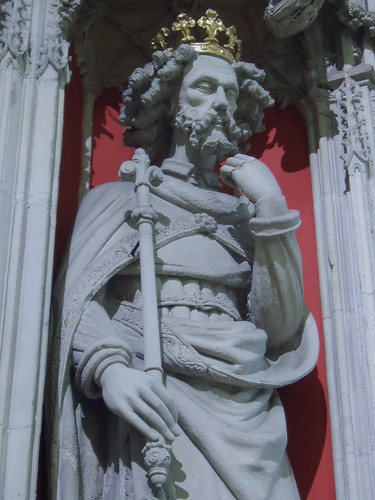
The portraiture, of course, comes from a single, briefer time frame than the Edwards' reigns; these images are not real time reflections, and would not have been taken as such. Rather, the features both individual and shared communicate something about kings in concept, and each of these kings' legacies in their particulars.
Edward II, not known as The Hammer of the Scots, nor for the long and prosperous rule of his son III, has a thoughtful mien about him. His left hand raised and wrist curving, his right holding NOT a sword. The lines of his height, his garments, are more broken, more complicated. He is belted, and he is draped in multiple directions. His head bows forward ever so slightly, and at a definite angle compared to his father. He appears to be contemplating something. Possibly, his thoughtful thousand-mile gaze could be seen as thought*less*, even stupid, the gesture of his hand equivocal, less strong than the others. What was I meant to see, looking at this figure? I may not see what was intended ...
Edward III, famed for a stupendously long reign, and often seen these days as having remediated some of the perceived sins of his father, looks almost as if he is answering someone. His brow is again furrowed, pressed downward, but his chin pointing upward. His beard is the longest and least curly; the lines of his garments, indicating his body beneath, are again long and straight, but like his father and unlike his grandfather Longshanks, he is belted. Girded. His mantle is thrown over his right shoulder, his arms free; again, he indicates motion. His hair may be the most startling of the three statues.
To III's right, the nearly beardless Richard II stands; the youth, the scion, the one who faced rebellions and a changing monarchy. His cheeks seem the faintest bit chubby. His forehead, his whole face indeed, is smooth and not caught in the extremity of expression of his forbears. His hair is almost horizontal. Richard's statue retains some pigment from its former painted decoration. Like his great-great grandfather, Richard bears a sword, its tip, strangely, lost in that hair. Like Longshanks and his grandfather, III, he is pointing at the viewer. Yet the impression is that we are looking at *youth*, looking at a king whose reign did not reach the maturity Edward III's long stint on the throne held and seasoned for England.


Richard II was the son of Edward the Black Prince, who did not live to ascend the throne. He was a boy-king, like Edward III had been before he overthrew the regency of his mother and her lover, Mortimer. Richard depended upon, and then fell out with, his uncle Lancaster and his cousin, the eventual Henry IV, whose son Henry V is reminding me for some reason of Martin Sheen in this link.
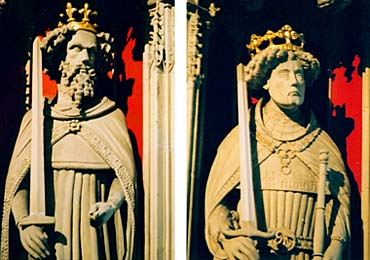
Henry has both hands full, and does not look to his viewers, eyes elevated, sword - we know - ever valiant. Ever more unto the breach, my friends.
Of all these figures, it is the Edwards who seem most alien to me, who arrest my attention. They are frankly ugly to my eyes. Startlingly so. Not as works of art, but as evocations of individuals, as portraits. The intensity is too much, the emphases uncanny.
To view the details of these statues closely, as is possible in photographs, was not the way they were made to be seen. Would have been inconceivable, when these were made. They reside, in physical reality, above the heads of anyone entering York Minster. And, for anyone standing in that consecrated place, it would even now be impossible to look at them with the care that we can in the reproductions and detail shots I have linked. It would in fact have been unseemly, in their day, to expend great attention on statues of kings - "what they looked like" - as a member of a religious congregation. And the multiplicity of these figures would have discouraged that sort of gazing.


The view when they were made did not allow the privilege of peering we have now.
As much particular attention as has been lavished on every one of the statues, the truth of the art was that they were meant to be part of a whole; elevated over the flesh-and-blood parishoners, but as much a part of the congregation gathered before G-d as lesser men. A mass of figures. These were statues glorifying the monarchy, certainly; even telling stories of each king's life and deeds. But they were ultimately part of the glorification of G-d - and the Church.
The potent energy of the Edwards may have been intended as part of a more en masse evocation of the intensity of worship, devotion, praise expected to be offered on this sacred ground.
Anyone who knows more of medieval art than I do - please disabuse me of any of these notions, or explain those aspects of what I am missing. I'd love to talk! These faces make me stop and stare every time.
All I can explain are those things I don't understand within the context of these works' creation - royalty itself; the finer points of Plantagenet politics or history; the specific legends of each of these individuals' reputations ... just how far these amazing portraits are even meant to be seen AS individuals. Allegorical implications. The filter of the history already passed between Longshanks and York Minster's decoration, so many generations later.
Wednesday, November 16, 2016
Tesserae - or - In Democracy, You Don't Necessarily Have to Rewrite History ...
 |
| Image: Wikipedia (detail) |
One of the reasons I love research is that, if you do it right, sometimes you learn a little bit more than "and then the Catholics enacted damnatio memoriae on Theodoric the Great, because he was Arian Christian."
In Ravenna, Italy, where Theodoric ruled and where most of my WIP takes place, is the Basilica of Sant'Apollinare Nuovo. Dedicated in 504 to Christ the Redeemer, it was his palace chapel. Theodoric subscribed to an early sect of Christianity known as Arianism, a non-trinitarian faith which was at the time of Theodoric and Clovis losing ground rapidly to a smaller, more obscure sect known as Catholicism.
After The Great King's death in 526, several political and religious (and yeah, same thing in many ways) forces combined to produce incalculable unexpected results.
Theodoric, who had spent his youth as a court hostage in Constantinople - honored, cared for, and almost undoubtedly educated by his captors, very definitely in favor with them and well liked by them - was rewritten by his own Ostrogothic nobility as an illiterate Barbarian. This picture of Theodoric the Great holds to this day in the popular imagination (so far as he's popularly remembered at all). Yet a cursory look at his career speaks to a different conclusion.
Also upon his death, the Catholic upsurge in Ravenna, Theodoric's seat as King of Italy, led to certain redecoration.
Look at the image above in another window, zoom a bit, let its details come clear. You will see a couple of disembodied hands.
The Church, taking over Christ the Redeemer when the king's palace chapel became the Catholic's basilica, made some edits to its mosaics and thematic decoration.
Theodoric's family were once framed in each arch showing in the mosaic above. His daughter, Amalasuntha, was one of the figures. Amalasuntha was one of those rare princesses who became a regnant queen - for a while. Theodoric had no sons, and she was his only legitimate offspring. Thus to her fell the responsibility for bearing a royal heir, which she did, but not to great effect. King Athalaric inherited as a child, apparently became dissolute in his youth, and died still under the regency of his mother.
Because I am a lying liar who lies ("writer"), at this point in drafting the manuscript (always note: with a WIP, anything I say and/or write is subject to change), the Catholic takeover of Redeemer, and their ascendancy, are accelerated a little. Not by multiple generations, but I pulled up the most likely time of their reconsecration of Redeemer, specifically, by roughly twenty-four years. Generally thought to have occurred in AD 560, I have it happening within about a decade of Theodoric's death.
The reason I pulled this piece of history into my historical fiction was to play parallels with the Ostrogoths' revisionist history of the Great King and the Catholics' damnatio memoriae of his dynasty, brief though that was.
The most striking thing about the latter events, in the symbol of those mosaics above, is the disembodied hands.
Imagine being the survivor of a dynasty that only survived three generations, looking up at the church your grandfather built, looking for the images of your family, your brother, your mother - and seeing only their maimed fingers or hands.
Irresistible scene, of course. I had to envision that.
But the reason those hands are most interesting is not the absence of everything else. It is their presence.
I've used the phrase damnatio memoriae - and, for the Romans and many other cultures throughout the world and through human history, destroying someone's name, removing them from the history books as it were, was a powerful tool. To be sure, we still remember those whose names have been stricken out. But that's not the point of a DM, not really.
The point of striking out a name is not to pretend "so and so never existed" ... but to point TO their existence, and to highlight the obliteration of anything so and so ever accomplished.
The disembodied hands are not an error, an incomplete obscurement of a vanquished opponent.
They are the reminder of the vanquishing.
We have erased something here, the images said. We have the power to remove—but we want to remind those we have supplanted.Damnatio memoriae was no obliteration. It was a reminder. This has been done, and we have undone.
--excerpt from the WIP
Possibly the deepest root of my patriotism lies in the pride I feel not only in voting, but in witnessing the peaceful transfer of power in the United States. I've participated for 30 years now as an active citizen, and watched this process for about forty-five. I remember Jimmy Carter's election, Reagan's - I remember Watergate, and the echoing word, "impeachment."
I remember the giddy sensation of watching the 2000 election, the fear then, the outrage. I don't expect to forget 2016 without illegal amounts of chemical intervention or outright dementia, neither of which appeals.
The new administration will do some amount of damnatio memoriae as it finds its way. ACA is on the block; many people's futures seem to be as well.
The American DM will not be a revision of history, it will be a change of what is envisioned.
Thursday, February 4, 2016
Dense, or Encompassing?
The work in progress has begun to insist to me that I have to work on a riot in which the citizens of my main setting burn down the synagogues.
Growing up, most of my closest friends were Jewish. My oldest friend, TEO The Elfin One, is not merely Jewish, but a teacher - a rabbi - as is her husband. I have known *about* anti-semitism all my life. But I have never KNOWN it.
To face this aspect of historical fiction, to know it must be a part of my own work, is not exactly difficult for me, but it is of course distasteful.
I've blogged before about how much I dislike writing battle scenes.
But writing what is, essentially, one of the earliest pogroms in what isn't even "Christendom" at this period ...
Ugh.
And it's not merely the content that daunts me, it is the wider prospect of the scene, as a part of its world.
Mr. X and I were emailing yesterday, and he was (as he has always been) one of my favorite readers, all "ooh and ahh" that I wrote the atheism post in like 15 minutes (I had been thinking about it for a day - if not, in some form, for months or years beforehand), and discussing the WIP and generally being that guy and that brain who ruined me for all the other guys' brains, and he said that this scene was going to be dense stuff.
And I thought about that.
And I realized that, if it were dense, it might almost be easier. Something that is dense is, perhaps, also self-contained. It has a shape, and boundaries ...
And this scene is encompassing, instead.
I need to contextualize this scene, this moment, this city of Ravenna in the year 519. It needs to be clear to see, in its place within Theodoric the Great's rule, and alongside Italy itself in this period ... when an old king has taken it on as his kingdom - and has no heir. It needs to have a view to Constantinople, which was becoming the new Rome, and where the Nika Riots would follow soon enough. It needs to find its place and focus in the larger picture of what people will insist upon calling the "Fall" of the Roman empire - and its connection to the imperial structures of Rome and of Constantinople, and also the so-called "Barbarian" cultures flourishing just to the north and west of Ravenna.
I need, too, to see the finer grain - to set this moment in the lives of my characters, and the marshy port city they occupied, to understand the weather and the moment and "why here"/"why now" ... The divisions between the minority Ostrogoths and the diversity of this place - the very scent of the wind, and the heat of the day ...
It's scary stuff. And not least because it is a riot, a racist mob setting fire to houses of worship.
And then comes the question.
How do I set this in the picture of the world I live in, myself?
Growing up, most of my closest friends were Jewish. My oldest friend, TEO The Elfin One, is not merely Jewish, but a teacher - a rabbi - as is her husband. I have known *about* anti-semitism all my life. But I have never KNOWN it.
To face this aspect of historical fiction, to know it must be a part of my own work, is not exactly difficult for me, but it is of course distasteful.
I've blogged before about how much I dislike writing battle scenes.
But writing what is, essentially, one of the earliest pogroms in what isn't even "Christendom" at this period ...
Ugh.
And it's not merely the content that daunts me, it is the wider prospect of the scene, as a part of its world.
Mr. X and I were emailing yesterday, and he was (as he has always been) one of my favorite readers, all "ooh and ahh" that I wrote the atheism post in like 15 minutes (I had been thinking about it for a day - if not, in some form, for months or years beforehand), and discussing the WIP and generally being that guy and that brain who ruined me for all the other guys' brains, and he said that this scene was going to be dense stuff.
And I thought about that.
And I realized that, if it were dense, it might almost be easier. Something that is dense is, perhaps, also self-contained. It has a shape, and boundaries ...
And this scene is encompassing, instead.
I need to contextualize this scene, this moment, this city of Ravenna in the year 519. It needs to be clear to see, in its place within Theodoric the Great's rule, and alongside Italy itself in this period ... when an old king has taken it on as his kingdom - and has no heir. It needs to have a view to Constantinople, which was becoming the new Rome, and where the Nika Riots would follow soon enough. It needs to find its place and focus in the larger picture of what people will insist upon calling the "Fall" of the Roman empire - and its connection to the imperial structures of Rome and of Constantinople, and also the so-called "Barbarian" cultures flourishing just to the north and west of Ravenna.
I need, too, to see the finer grain - to set this moment in the lives of my characters, and the marshy port city they occupied, to understand the weather and the moment and "why here"/"why now" ... The divisions between the minority Ostrogoths and the diversity of this place - the very scent of the wind, and the heat of the day ...
It's scary stuff. And not least because it is a riot, a racist mob setting fire to houses of worship.
And then comes the question.
How do I set this in the picture of the world I live in, myself?
Monday, February 1, 2016
Tools
There are times it frustrates me when people say they are atheists because of what people have done in the name of religion. PEOPLE do dunderheaded things in the name of all sorts of things, and though religion does have extreme examples, there are also extreme idiots (Richard Dawkins) screaming passionately about their atheism. He's as dangerous as any other zealot; and that is the issue: zealotry in human hands is the problem. Not G-d.
To withdraw belief in G-d because of human behavior honestly bewilders me.
It's like me and not having kids.
I never had children because I never experienced the bone-deep desire - the *urge* (so named because of its *urgency*) to have a child.
This seems to me the very best of reasons never to have them. There have been other thoughts on the matter that have been a part of my life, but at bottom it's the simple absence of need to procreate or adopt, to be a parent, that has been ultimately responsible.
So I can see, very easily, the absence of need for G-d ... and for faith.
But many of the atheists I know once HAD faith - and lost it, because of other people. They experienced disillusionment and shame in religion, because of the jerks who espouse it (whether their own or not) and decided against G-d, because of man.
I suppose this is overwhelmingly arrogant: but this bewilders me.
Anything hideous ever done in the name of religion came about by the hands, and the tongues, of human beings.
Religion is a tool. It can be a poor tool, misused, No doubt about it. So can science and history; my blog is filled with examples of the wrongheaded invocation of history, the way we think it's some sort of plotline leading ever-onward to betterment, and how that must mean humanity now is the best humanity history has ever seen, because: history equals evolution.
Which: no.
So I ABSOLUTELY concur, that there are a hell of a lot of people out there blunting their blades, hammering with a tool meant to cut through confusion, or mistaking the philosophy and questioning of faith for final, firm truth.
But the idea that we then throw out all the tools, instead of sharpening or learning how to use them (for those interested in what those tools have wrought, or could) ...
Isn't that the very last word in Luddite behavior? "It's of no use to me and it scares me, so HULK SMASH!" ... ?
Again: yes. The tools of religion have hurt many people. So have the tools that created the thing we call culture, or advancement. Innovation requires tools.
For me, it is an innovation of the highest order to grow spiritually.
I tried to do that without tools, without a congregation, without inspiration. I ended up making up a lot of religious tools for myself. Offerings, prayers, little personal rituals.
And it got me to a point where I felt I wasn't really that good an innovator, and I needed the help of something outside my own wee and paltry brain.
I reached for religion. My church.
There I found the literally-angelic voice that perhaps inspired me most, but I also found Miss B., with whom I sat at yesterday's services. She was the first who ever welcomed me in the congregation, and she is the very, joyous definition of Christian fellowship. Not because we sit around quoting bible verses at one another. But because she saw me alone as a guest, and made me a member, as fully and as lovingly as education and confirmation and that bishop who laid hands on my head.
Religion, for me - as filled with ritual and script as my church is - is far less about dogma, and so much about communion: the communion of souls. Of just nice PEOPLE. Of congregation. Coming together, and sharing the sunshine yesterday. That is a religious act as profound as the eating of an intincted wafer.
I may still not be the craftsman, with my tools, that (oh, say) Jesus, who was a carpenter, was. But I am part of a team now, a crew, a congregation. Of people I honestly do love, though I spend little time with them of late. And appreciate and respect.
I found the phrase, "Okay, we're past the angelic robes and the beard and the penis, and we're onto something BIGGER!" one day over lunch ...
Faith and hope and growing spiritually? Yes, go big.
Why try for faith, without exultation?
What else is faith for but to bring us together as human beings, and what else, at bottom, does ANY religion foster? Even those religions we condemn as perverted - geared toward exclusion as much as inclusion - geared toward WINNING, and punishment of sin - still require one heart and mind to link to another, and another.
We're only human. We don't always do that well. We don't do it well in business or in study, in reaching goals or explaining them. It's not religion's fault.
And human behavior is human behavior - and flawed, as often as it is beautiful - in the pursuit of whatever it is we do to connect ourselves to others.
An ass in a choir robe is just as much of an ass once the robe is doffed and hymns are suddenly to blame for all that is wrong in the world. The robe didn't sin, neither (perhaps) did the hymn. They were there before disillusionment, and they'll be there after.
If I am a poor painter, I don't blame the brush; not even the paint. It lies within me to learn, or not. Perhaps it lies within me to know I'm a better writer than I am an artist.
But it's not the tools' fault, if I don't sell paintings for stunning pricetags.
To withdraw belief in G-d because of human behavior honestly bewilders me.
It's like me and not having kids.
I never had children because I never experienced the bone-deep desire - the *urge* (so named because of its *urgency*) to have a child.
This seems to me the very best of reasons never to have them. There have been other thoughts on the matter that have been a part of my life, but at bottom it's the simple absence of need to procreate or adopt, to be a parent, that has been ultimately responsible.
So I can see, very easily, the absence of need for G-d ... and for faith.
But many of the atheists I know once HAD faith - and lost it, because of other people. They experienced disillusionment and shame in religion, because of the jerks who espouse it (whether their own or not) and decided against G-d, because of man.
I suppose this is overwhelmingly arrogant: but this bewilders me.
Anything hideous ever done in the name of religion came about by the hands, and the tongues, of human beings.
Religion is a tool. It can be a poor tool, misused, No doubt about it. So can science and history; my blog is filled with examples of the wrongheaded invocation of history, the way we think it's some sort of plotline leading ever-onward to betterment, and how that must mean humanity now is the best humanity history has ever seen, because: history equals evolution.
Which: no.
So I ABSOLUTELY concur, that there are a hell of a lot of people out there blunting their blades, hammering with a tool meant to cut through confusion, or mistaking the philosophy and questioning of faith for final, firm truth.
But the idea that we then throw out all the tools, instead of sharpening or learning how to use them (for those interested in what those tools have wrought, or could) ...
Isn't that the very last word in Luddite behavior? "It's of no use to me and it scares me, so HULK SMASH!" ... ?
Again: yes. The tools of religion have hurt many people. So have the tools that created the thing we call culture, or advancement. Innovation requires tools.
For me, it is an innovation of the highest order to grow spiritually.
I tried to do that without tools, without a congregation, without inspiration. I ended up making up a lot of religious tools for myself. Offerings, prayers, little personal rituals.
And it got me to a point where I felt I wasn't really that good an innovator, and I needed the help of something outside my own wee and paltry brain.
I reached for religion. My church.
There I found the literally-angelic voice that perhaps inspired me most, but I also found Miss B., with whom I sat at yesterday's services. She was the first who ever welcomed me in the congregation, and she is the very, joyous definition of Christian fellowship. Not because we sit around quoting bible verses at one another. But because she saw me alone as a guest, and made me a member, as fully and as lovingly as education and confirmation and that bishop who laid hands on my head.
Religion, for me - as filled with ritual and script as my church is - is far less about dogma, and so much about communion: the communion of souls. Of just nice PEOPLE. Of congregation. Coming together, and sharing the sunshine yesterday. That is a religious act as profound as the eating of an intincted wafer.
I may still not be the craftsman, with my tools, that (oh, say) Jesus, who was a carpenter, was. But I am part of a team now, a crew, a congregation. Of people I honestly do love, though I spend little time with them of late. And appreciate and respect.
I found the phrase, "Okay, we're past the angelic robes and the beard and the penis, and we're onto something BIGGER!" one day over lunch ...
Faith and hope and growing spiritually? Yes, go big.
Why try for faith, without exultation?
What else is faith for but to bring us together as human beings, and what else, at bottom, does ANY religion foster? Even those religions we condemn as perverted - geared toward exclusion as much as inclusion - geared toward WINNING, and punishment of sin - still require one heart and mind to link to another, and another.
We're only human. We don't always do that well. We don't do it well in business or in study, in reaching goals or explaining them. It's not religion's fault.
And human behavior is human behavior - and flawed, as often as it is beautiful - in the pursuit of whatever it is we do to connect ourselves to others.
An ass in a choir robe is just as much of an ass once the robe is doffed and hymns are suddenly to blame for all that is wrong in the world. The robe didn't sin, neither (perhaps) did the hymn. They were there before disillusionment, and they'll be there after.
If I am a poor painter, I don't blame the brush; not even the paint. It lies within me to learn, or not. Perhaps it lies within me to know I'm a better writer than I am an artist.
But it's not the tools' fault, if I don't sell paintings for stunning pricetags.
Sunday, September 27, 2015
Late Night Collection
This blog hasn't been getting its usual effort of late, but I've been watching others', and I'm behind on sharing them. So here we are, let's get to the links!
Arrant Pedantry has - you guessed it - a bit more deconstructing pedantry, this time a look at the usage of the word anxious.
I haven't shared a Gary Corby link in far too long. Here, he explains the origin of the term - and the original rite - of catharsis.
Mojourner Truth has done a series of wonderful photos recently, on archaeological work and features in Hawai'i. The sled run here is one of my favorite of these posts!
Also, Mojourner is really funny. Sir Mo's A Lot - heh.
American Duchess shows us a little something about the history of 1940s shoe fashion - and beyond!
AD also has Scandalous Tango Boots! (And, some time in December, so will I!)
Jessica Faust has a good story at Bookends' blog's new home, about how she got a certain client in Days of Yore - lo, fifteen years ago, when he space-age material "paper" was involved in querying.
And last, but without a doubt not least, Tom Williams looks at nomenclature and rather a lot more. "Freedom Struggle"? "War of Independence"? ... or "Mutiny"?
Arrant Pedantry has - you guessed it - a bit more deconstructing pedantry, this time a look at the usage of the word anxious.
I haven't shared a Gary Corby link in far too long. Here, he explains the origin of the term - and the original rite - of catharsis.
Mojourner Truth has done a series of wonderful photos recently, on archaeological work and features in Hawai'i. The sled run here is one of my favorite of these posts!
Also, Mojourner is really funny. Sir Mo's A Lot - heh.
American Duchess shows us a little something about the history of 1940s shoe fashion - and beyond!
AD also has Scandalous Tango Boots! (And, some time in December, so will I!)
Jessica Faust has a good story at Bookends' blog's new home, about how she got a certain client in Days of Yore - lo, fifteen years ago, when he space-age material "paper" was involved in querying.
And last, but without a doubt not least, Tom Williams looks at nomenclature and rather a lot more. "Freedom Struggle"? "War of Independence"? ... or "Mutiny"?
Monday, August 3, 2015
Collection
On "performing" the seven deadly sins (without actual commission!). One should be "sharp when expounding, stern when correcting and kindly when exhorting." (For those who are uber-nerdy on this subject, the full paper is here.)
An interesting essay contest - in which a farm is the prize ...
Cue Mission Impossible theme music: the intel in monkey feces - or "Why Primatologists Love to Collect Poo" - best headline I've seen today.
Primary sources are the best. Medieval Jews' writings on Christianity and Christians, from the Eucharist to money lending.
An interesting essay contest - in which a farm is the prize ...
Cue Mission Impossible theme music: the intel in monkey feces - or "Why Primatologists Love to Collect Poo" - best headline I've seen today.
Primary sources are the best. Medieval Jews' writings on Christianity and Christians, from the Eucharist to money lending.
Saturday, June 27, 2015
Collection
Nyki Blatchley has a great post about adaptations which differ from their sources; the point he makes about "Female character? Love interest, obviously" is pure gold. (His thoughts make a very good counterpoint to the recent piece I linked on the possible utility of anachronism and its place in historicals)
The BookEnds blog has a good look at the new-author issue of "what if they steal my story!!??" by way of a possible plot bunny. (So, my writing readers, you have been warned before you click!)
The History Blog also provides *serious* plot bunny fodder with this post: how did the foetus come to rest beneath the bishop's robes? Impossibly tempting material!
The BookEnds blog has a good look at the new-author issue of "what if they steal my story!!??" by way of a possible plot bunny. (So, my writing readers, you have been warned before you click!)
The History Blog also provides *serious* plot bunny fodder with this post: how did the foetus come to rest beneath the bishop's robes? Impossibly tempting material!
Wednesday, October 29, 2014
Collection
Today was about an eleven hour day at work, and tomorrow should be about the same, but I could not resist sharing two links from my daily reading.
First, the HB interviews Brian Willson of Three Islands Press font design. (Worth the side trip of a separate click: Janet Stephens' historical hair designs, but I've posted her before, so back to the subject at hand.) Willson creates historical handwriting fonts. How enchanting!
Next, take a look at Elizabeth Chadwick's possibly-Elizabethan chair, which is art, furniture, artifact, and a tantalizing clue to an architectural aspect of English ecclesiastical history. If I weren't about to go to bed, I'd be researching Victorian restorations right now to see if the "junk" heirloom might have come from one of these refurbishments. But I am probably late to sign off and get ready for bed as it is, so will leave you all to it!
First, the HB interviews Brian Willson of Three Islands Press font design. (Worth the side trip of a separate click: Janet Stephens' historical hair designs, but I've posted her before, so back to the subject at hand.) Willson creates historical handwriting fonts. How enchanting!
Next, take a look at Elizabeth Chadwick's possibly-Elizabethan chair, which is art, furniture, artifact, and a tantalizing clue to an architectural aspect of English ecclesiastical history. If I weren't about to go to bed, I'd be researching Victorian restorations right now to see if the "junk" heirloom might have come from one of these refurbishments. But I am probably late to sign off and get ready for bed as it is, so will leave you all to it!
Thursday, September 4, 2014
Collection
It's a funny thing someone happened to hit this post today and remind me of it by bumping it onto my stats. The white egret is a close cousin of the blue heron - and its symbolic connection with self-determination has come to mean a lot to me.
Gossie took a mini vacation this past weekend, and it reminded me that I have not linked Janet Reid for at least a minute and a half. So here we rectify this lapse, with her advice to authors about First3Chapters. *Eyebrow*
Dusting the vestments ... ? Fabric over a millennium and a half old is, as anyone might guess, vanishingly thin on the ground - and its conservation is a fascinating science, craft, and story spanning far, far longer than St. Ambrose's life.
For this link, do you prefer Door #1 (NatGeo), Door #2 (BBC), or Door #3 (Nature) to read about the tantalizing possibility of Neanderthal art nearly forty-thousand years old ... ? This is one of those stories where the debate in the field (har ...) is almost as interesting as the hopes and theories themselves. The questions are wonderfully unanswerable.
Gossie took a mini vacation this past weekend, and it reminded me that I have not linked Janet Reid for at least a minute and a half. So here we rectify this lapse, with her advice to authors about First3Chapters. *Eyebrow*
Dusting the vestments ... ? Fabric over a millennium and a half old is, as anyone might guess, vanishingly thin on the ground - and its conservation is a fascinating science, craft, and story spanning far, far longer than St. Ambrose's life.
For this link, do you prefer Door #1 (NatGeo), Door #2 (BBC), or Door #3 (Nature) to read about the tantalizing possibility of Neanderthal art nearly forty-thousand years old ... ? This is one of those stories where the debate in the field (har ...) is almost as interesting as the hopes and theories themselves. The questions are wonderfully unanswerable.
Sunday, August 17, 2014
Collection
I haven't linked Unleaded Fuel for Writers in too long. So let's go there. Day Al-Mohamed shared this great infographic of the ultimate writers' retreat ... who's going with me?
Helena P. Shrader on the English History Authors blog takes a look at the Seven Deadly Sins ... and what they say about who were most preoccupied with them ...
History Extra takes a look into Richard III's rib bone. The science of how we determined the culinary history of his life FASCINATES me. Yet the indicators of luxury upon his accession are definitely telling.
Helena P. Shrader on the English History Authors blog takes a look at the Seven Deadly Sins ... and what they say about who were most preoccupied with them ...
History Extra takes a look into Richard III's rib bone. The science of how we determined the culinary history of his life FASCINATES me. Yet the indicators of luxury upon his accession are definitely telling.
Friday, August 8, 2014
Queen Saint Clotilde's Life
I have not neglected to post about Clotilde, but I have failed in one thing, and that is to point out that she was in her time a VERY long-lived lady indeed.
In The Ax and the Vase, I placed her marriage to Clovis I at about age nineteen in 493 CE. She was married to him until his death in 511, and so they had a little less than twenty years.
Given that Clotilde lived about SEVENTY years, it’s difficult to put her marriage into perspective. All of the history touching on her centers upon the marriage, and even the tales of her life as a supposed bloodthirsty revenge-machine after his death, inciting war over decades-old other imaginary murders, tend to be brief in comparison with the hagiography of the saint who brought a king to Catholic Christianity.
The history of Christendom focuses heavily on Clovis I, First Catholic King in Europe – and, to be sure, I have myself framed The Ax and the Vase as exactly that story. Clotilde’s role is venerated, and she earned her entire fame in history by being the importuning wife who brought a king to the Church – yet she herself is rarely examined except through the lens of her husband, her sons. We have no tales of her alone, outside the context of the marriage and her children. And that’s not the exclusive case of Frankish women in history.
Clotilde is, if we take what sources we have at historical value (we shouldn’t), the catalyst, the instigator. It’s clear her personality was strong – and yet, the person passed down through the centuries is never her own. Always the daughter, the wife, the mother, Clotilde is in some ways obscured by the very act which brought her the greatest power and the enduring fame of fifteen hundred years’ sanctification.
If Clovis was the first Catholic king in Europe, the mighty precedent of a faith and tradition which set the very course of western history itself after Rome’s “fall” …
Clotilde is the woman, the heart, the impetus, the persuader – who made it happen.
Clovis tends generally to be cast either as a Christian of the Arian faith – or, more often, as an outright pagan. Historians and enthusiasts squabble enjoyably about “what kind” of pagan he was, but there is no question, his coming to Catholicism was both unexpectedly nonconformist in his day, and an epochal event in Gaul and, eventually, beyond.
If it had not been for the will of his wife, it’s quite possible Clovis never would have come to the Church.
Now, think about that. Really consider – the course of European life for a thousand years, until the Reformation, the rebellion against that church, the extent and influence of the Catholic Church in most people’s lives and expectations, for so many centuries. Think about the complexion of the world if he had been and remained a non-trinitarian Christian. If he had never converted, and the Church grew, but never quite integrated with the royal houses of Europe as it was able to partially thanks to Clovis’ precedent. The feudal world would have looked very different – the material world would have, without cathedrals and basilicas coming to represent and to attract the wealth and trade of cities. Consider the increasingly-bound ties, through generations and centruies, of throne and mitre, of money and influence – and the very morality and way of life of such a vast swath of time and humanity.
Imagine that one of the fundamental precedents that set THIS world in motion, never occurred. That Clovis never looked critically at the Roman Church – spiritual scion of the Roman empire he had assisted to *extinguish* in Gaul – that he remained Arian, or pagan, or perhaps that he did convert, but was never so powerful a monarch as he was to become. Imagine a Catholic king surrounded by Arians and pagans, who succumbed to defeat at their hands, or who stayed at three small cities in Belgium, and was no tool for a growing Church to gain greater influence and power – and followers.
Because the followers – that is perhaps the greatest key to Clovis’ conversion and baptism, and their eventual effects and influence.
Clovis came to power by the CHARISMA of his blood. And the stories of the thousands who followed him in ecstasies to the Catholic faith are consistent, whatever else we may say of the veracity or dependability of sources for Late Antiquity. So are the tales of new converts who lashed out against Arians and pagans in the wake of the fervor accompanying the massive acceptance of Catholicism.
It is Clotilde, a woman Clovis may in part have chosen to marry precisely because of her religious connections, who brought him from friendly correspondence with bishops, to actual submission to her faith.
It is Clotilde, who lived seventy years – nearly three decades after the death of her king – whose influence on one man rendered so many more susceptible to conversion, to baptism, to the Church she had in fact importuned upon him for many years before he accepted.
Clotilde baptized their first son against the will of Clovis – and that son died.
Clovis resisted her testimony, her witnessing, for years – until, on the field of battle, he finally is said to have laid himself in HER G-d’s hands, and gained victory. Became the king he did become. And forged his relationship with her Church.
The thirty years after Clovis’ death seeem almost to bear no relationship to the foregoing tales of her conviction, her purity in faith. The character left to history devolves to a vicious queen out to right ancient family wrongs, in revenge for her father’s (purported) murder – bringing Burgundy to war, and setting her sons to acts of bitterness and revenge which seem not only out of character with the story of Clovis’ life, but out of character with her own youth and queenship.
It is puzzling, in any research (or just causal reading) of a period, to come across a character so lionized and so demonized all at once, yet it is hardly uncommon. Just as the saint and queen, depicted in her youth and matronhood as the highest ideal may become a crone obsessed with long-gone wrongs … a young woman of power and hope may become a poisoner, the tool of a story meant to illustrate sin and the worst in her gender. For that matter, even the young warrior may become, over years of propaganda and lost human motivation, the scapegoat vilified for liking little boys, dissipated in wine and shame for a new king to conquer and damn him. Ahem.
Over the years and years I have spent reading about all the figures of the time, I’ve found reason to doubt almost all the worst tales told. Propaganda plays an enormous role in The Ax and the Vase, and anyone who reads it should keep in mind both that and the fact that the novel is told in first-person. I consciously set Clovis up as a somewhat unreliable (and, in that bargain – *incomplete*) narrator, just as I make explicit every piece of propaganda he set forth – the making of his own legend.
The result ends up being that, though I feel her character has blood in her veins and flesh on her bones, Clotilde is done little more justice as a figure in history itself than she is most anywhere else.
None of us lives our lives with great attention paid to our posterity. Those few who do often rotate around an axis of vanity; and personal forms of propaganda, at that – the well-chosen selfie, the stories told or posted subjectively. Whether self-aware or not, we’re all writing our own life’s stories, and to author our lives with consideration far beyond how we look in the immediate is close to unheard-of. So I couldn’t really write a novel in first-person, by a husband often frustrated by his queen – by a *man*, who could not see the woman in his bed as a saint nor a part of history – and DO her that justice.
I hope my readers do her a little better, and see beyond the constraints of creative narrative.
I know some, surely, see beyond the saint and the bitter dowager. And see a remarkable woman, long-lived, and more than the sum of her husband, and her children.
In The Ax and the Vase, I placed her marriage to Clovis I at about age nineteen in 493 CE. She was married to him until his death in 511, and so they had a little less than twenty years.
Given that Clotilde lived about SEVENTY years, it’s difficult to put her marriage into perspective. All of the history touching on her centers upon the marriage, and even the tales of her life as a supposed bloodthirsty revenge-machine after his death, inciting war over decades-old other imaginary murders, tend to be brief in comparison with the hagiography of the saint who brought a king to Catholic Christianity.
The history of Christendom focuses heavily on Clovis I, First Catholic King in Europe – and, to be sure, I have myself framed The Ax and the Vase as exactly that story. Clotilde’s role is venerated, and she earned her entire fame in history by being the importuning wife who brought a king to the Church – yet she herself is rarely examined except through the lens of her husband, her sons. We have no tales of her alone, outside the context of the marriage and her children. And that’s not the exclusive case of Frankish women in history.
Clotilde is, if we take what sources we have at historical value (we shouldn’t), the catalyst, the instigator. It’s clear her personality was strong – and yet, the person passed down through the centuries is never her own. Always the daughter, the wife, the mother, Clotilde is in some ways obscured by the very act which brought her the greatest power and the enduring fame of fifteen hundred years’ sanctification.
If Clovis was the first Catholic king in Europe, the mighty precedent of a faith and tradition which set the very course of western history itself after Rome’s “fall” …
Clotilde is the woman, the heart, the impetus, the persuader – who made it happen.
Clovis tends generally to be cast either as a Christian of the Arian faith – or, more often, as an outright pagan. Historians and enthusiasts squabble enjoyably about “what kind” of pagan he was, but there is no question, his coming to Catholicism was both unexpectedly nonconformist in his day, and an epochal event in Gaul and, eventually, beyond.
If it had not been for the will of his wife, it’s quite possible Clovis never would have come to the Church.
Now, think about that. Really consider – the course of European life for a thousand years, until the Reformation, the rebellion against that church, the extent and influence of the Catholic Church in most people’s lives and expectations, for so many centuries. Think about the complexion of the world if he had been and remained a non-trinitarian Christian. If he had never converted, and the Church grew, but never quite integrated with the royal houses of Europe as it was able to partially thanks to Clovis’ precedent. The feudal world would have looked very different – the material world would have, without cathedrals and basilicas coming to represent and to attract the wealth and trade of cities. Consider the increasingly-bound ties, through generations and centruies, of throne and mitre, of money and influence – and the very morality and way of life of such a vast swath of time and humanity.
Imagine that one of the fundamental precedents that set THIS world in motion, never occurred. That Clovis never looked critically at the Roman Church – spiritual scion of the Roman empire he had assisted to *extinguish* in Gaul – that he remained Arian, or pagan, or perhaps that he did convert, but was never so powerful a monarch as he was to become. Imagine a Catholic king surrounded by Arians and pagans, who succumbed to defeat at their hands, or who stayed at three small cities in Belgium, and was no tool for a growing Church to gain greater influence and power – and followers.
Because the followers – that is perhaps the greatest key to Clovis’ conversion and baptism, and their eventual effects and influence.
Clovis came to power by the CHARISMA of his blood. And the stories of the thousands who followed him in ecstasies to the Catholic faith are consistent, whatever else we may say of the veracity or dependability of sources for Late Antiquity. So are the tales of new converts who lashed out against Arians and pagans in the wake of the fervor accompanying the massive acceptance of Catholicism.
It is Clotilde, a woman Clovis may in part have chosen to marry precisely because of her religious connections, who brought him from friendly correspondence with bishops, to actual submission to her faith.
It is Clotilde, who lived seventy years – nearly three decades after the death of her king – whose influence on one man rendered so many more susceptible to conversion, to baptism, to the Church she had in fact importuned upon him for many years before he accepted.
Clotilde baptized their first son against the will of Clovis – and that son died.
Clovis resisted her testimony, her witnessing, for years – until, on the field of battle, he finally is said to have laid himself in HER G-d’s hands, and gained victory. Became the king he did become. And forged his relationship with her Church.
The thirty years after Clovis’ death seeem almost to bear no relationship to the foregoing tales of her conviction, her purity in faith. The character left to history devolves to a vicious queen out to right ancient family wrongs, in revenge for her father’s (purported) murder – bringing Burgundy to war, and setting her sons to acts of bitterness and revenge which seem not only out of character with the story of Clovis’ life, but out of character with her own youth and queenship.
It is puzzling, in any research (or just causal reading) of a period, to come across a character so lionized and so demonized all at once, yet it is hardly uncommon. Just as the saint and queen, depicted in her youth and matronhood as the highest ideal may become a crone obsessed with long-gone wrongs … a young woman of power and hope may become a poisoner, the tool of a story meant to illustrate sin and the worst in her gender. For that matter, even the young warrior may become, over years of propaganda and lost human motivation, the scapegoat vilified for liking little boys, dissipated in wine and shame for a new king to conquer and damn him. Ahem.
Over the years and years I have spent reading about all the figures of the time, I’ve found reason to doubt almost all the worst tales told. Propaganda plays an enormous role in The Ax and the Vase, and anyone who reads it should keep in mind both that and the fact that the novel is told in first-person. I consciously set Clovis up as a somewhat unreliable (and, in that bargain – *incomplete*) narrator, just as I make explicit every piece of propaganda he set forth – the making of his own legend.
The result ends up being that, though I feel her character has blood in her veins and flesh on her bones, Clotilde is done little more justice as a figure in history itself than she is most anywhere else.
None of us lives our lives with great attention paid to our posterity. Those few who do often rotate around an axis of vanity; and personal forms of propaganda, at that – the well-chosen selfie, the stories told or posted subjectively. Whether self-aware or not, we’re all writing our own life’s stories, and to author our lives with consideration far beyond how we look in the immediate is close to unheard-of. So I couldn’t really write a novel in first-person, by a husband often frustrated by his queen – by a *man*, who could not see the woman in his bed as a saint nor a part of history – and DO her that justice.
I hope my readers do her a little better, and see beyond the constraints of creative narrative.
I know some, surely, see beyond the saint and the bitter dowager. And see a remarkable woman, long-lived, and more than the sum of her husband, and her children.
Thursday, July 24, 2014
Author's Notes
Today, Clovis' two comes come in at the top, followed by a look at the type of king he was (literally, literally), and I thought we should round off this post with the Saint who baptized the King.
PHARAMOND
FICTIONAL; originally called Merovech, I changed this character’s name the moment someone fist asked me about Dan Brown. Pharamond’s name does belong to another semi-historical/legendary king of the Franks.
RAGNACHAR
Ragnachar is a historical king, seated at Cambrai, and known to have fought beside his kinsman, Clovis. Tales of him dating from Gregory of Tours’ day depict a dissolute, villain enough to make even Childeric’s early dissipations mild by comparison. Though there is always room for the possibility of bias and propaganda in primary sources, rehabilitation/revisionism would do away with too many good stories in this case, and so we have the older, less-powerful cousin who both envies and ties himself—for a time, loyally—to the arc of Clovis’ much brighter star. The tales of “my Farro” come largely as recorded in sources; and, of course, one can take the particular type of sexual slurs against Ragnachar with all the veracity that belongs to Clotilde’s bloodthirsty family and some of the more magical legends attached to Clovis himself.
REGES CRINITI
“Long-haired kings”; Franks of the period attached symbolic importance to hair, and their kings wore long hair as a badge both of power and position. Stories abound of those who were shorn or tonsured like monks in a metaphorical display of their loss of authority. As is illustrated in Clotilde’s threats to the young son of Chararic and the aftermath, for a victim of being shorn thus to even speak of growing his hair back was a clear threat to any king who wanted to see him stripped of power.
Tangentially related to this is the reference to Basina’s scalping, after her adultery. This was intended to echo as much the fate of Morgause at her son Gaheris’ hand, as to reflect the connection to the archetypal power of long hair for Frankish royalty.
REMIGIUS
Bishop Remigius of Rheims, born 437, lived to the year 533. By the time of Clovis’ baptism (as calculated from 508, rather than 496), he had already attained seventy-one years, and he eventually far outlived Clovis himself, surviving to the impressive age of nearly ninety-six. This alone would have lent him a literal venerability, and his character certainly lent Remi a fame at least as great, if not even greater, than Clovis’ own.
As always, Author's Notes excerpts are excerpted from the MS, which means they are written "in-universe." These posts should not be taken as historical resources.
PHARAMOND
FICTIONAL; originally called Merovech, I changed this character’s name the moment someone fist asked me about Dan Brown. Pharamond’s name does belong to another semi-historical/legendary king of the Franks.
RAGNACHAR
Ragnachar is a historical king, seated at Cambrai, and known to have fought beside his kinsman, Clovis. Tales of him dating from Gregory of Tours’ day depict a dissolute, villain enough to make even Childeric’s early dissipations mild by comparison. Though there is always room for the possibility of bias and propaganda in primary sources, rehabilitation/revisionism would do away with too many good stories in this case, and so we have the older, less-powerful cousin who both envies and ties himself—for a time, loyally—to the arc of Clovis’ much brighter star. The tales of “my Farro” come largely as recorded in sources; and, of course, one can take the particular type of sexual slurs against Ragnachar with all the veracity that belongs to Clotilde’s bloodthirsty family and some of the more magical legends attached to Clovis himself.
REGES CRINITI
“Long-haired kings”; Franks of the period attached symbolic importance to hair, and their kings wore long hair as a badge both of power and position. Stories abound of those who were shorn or tonsured like monks in a metaphorical display of their loss of authority. As is illustrated in Clotilde’s threats to the young son of Chararic and the aftermath, for a victim of being shorn thus to even speak of growing his hair back was a clear threat to any king who wanted to see him stripped of power.
Tangentially related to this is the reference to Basina’s scalping, after her adultery. This was intended to echo as much the fate of Morgause at her son Gaheris’ hand, as to reflect the connection to the archetypal power of long hair for Frankish royalty.
REMIGIUS
Bishop Remigius of Rheims, born 437, lived to the year 533. By the time of Clovis’ baptism (as calculated from 508, rather than 496), he had already attained seventy-one years, and he eventually far outlived Clovis himself, surviving to the impressive age of nearly ninety-six. This alone would have lent him a literal venerability, and his character certainly lent Remi a fame at least as great, if not even greater, than Clovis’ own.
As always, Author's Notes excerpts are excerpted from the MS, which means they are written "in-universe." These posts should not be taken as historical resources.
Subscribe to:
Posts (Atom)