The sun is back out. America's midterm elections are over. My friend V ... well. Losing her is awful, it's cruel. But she is not hurting now. Doctors can't use her body to experiment now. And those who love her - I am humbled they embrace me. Her husband, her family, her beloved friends: beautiful, beautiful, wonderful people.
This time has been hard. Like so many families, the remains of our nuclear unit - just me, mom, and my brother now - endure terrible political strain in these times. But, just for this morning, it's virtual hugs and three courses of "I love you." Because these strains have everyday, real consequences - this has, in some ways, been even harder than watching my lifelong friend die. Or, perhaps, it only got in the way of comprehending and mourning. I only know this has been the hardest thing to bear, over this past week.
We are all enduring a confluence. My brother is traveling to the memorial of a friend of his, and beautiful V's will be remembered on Saturday. As her kids do this, my mom is now watching her own oldest friend in town "giving back", as some say in the South. It may be we all suffer the loss of our dear Deebo, my stepfather - and each of our dear friends.
The light of inspiration peeked out not too long ago - unsurprisingly, after The Conference, but also very much under the influence of other friendships. Leila, especially, uniquely lights my creative way. She and I have so much in common, but we write such different works, and about the time I did a recent beta-read for her, I also happened to find the ENDING for a short work we began an embarrassing number of years ago in our writing group. It's been drafted two different ways, I let it settle in a certain direction, and for now it is sitting quietly, resting, rising, awaiting both her feedback and my final attentions.
Writing. Feels. So. Good.
There truly is nothing else like writing.
And so, with voting done and the sun out and my family whole ... I open up the WIP, the big dog, the "real" work. The novel. Just open it. I shall scroll about in it, find something to alight upon, and read a little bit.
Research feels like a good way to go. I fear it may have to be, at long last, the pogrom. (Yes, now, of all moments.)
Sometimes, the way writing feels "good" is different from other times. It's not always pleasure.
Sometimes, it's memorial.
Showing posts with label excuses to write. Show all posts
Showing posts with label excuses to write. Show all posts
Wednesday, November 7, 2018

Thursday, October 18, 2018
I'm feelin' it!
2018 has not been a prolific year for me with writing. The blog has been a bit weirder, I know; and any activity I've indulged on Twitter's #AmWriting has been sporadic, if not an outright lie (in attempts to convince myself).
Lots of this owes to the facts of life - well, and death. But yesterday, there was some good news. This past weekend, there was The Conference - and, though I had hardly thought about it and wasn't even sure I was up for it, it was kind to me (even beyond seeing my WONDERFUL writing friends in the most glorious community you could ask for), and ... I feel like writing again. Maybe not the WIP, at least for a minute. Maybe time to take another look at that ghost story I've been trying to find the MDQ for for, literally, years. Maybe take a piece of The Ax and the Vase, and develop that ... Basina, or Lanthechilde (who was cut out of Ax entirely, actually). Maybe something altogether new.
It'll let me know.
In the meantime: we have spotted the sun a couple times of late, locally. It is not humid. The heat is finally letting go. Tomorrow is Friday (and pay day). One of my oldest friends, apparently is not dying. (This is was not a given, two weeks ago.) My mom's still in a bit of a state, but I am planning ways for the two of us to have a good time together. I've got some ideas.
Today is a blessing.
May yours be even moreso.
Friday, September 14, 2018
Collection
The hard-knockers won...
How about a good old history-of-fashion link again, for the first time in a while? Or would you prefer astronomical pursuits? Here we have science and style in one. "My seamless isn't space-less anymore!" Or is "My Barbaloot (space) suit's a convolute!" better? Hidden figure shapers? Choose your pun ... Either way, click away; worth the story, especially its ending. On the development of NASA's first space suits - by way of Racked.
You don't wick power from the powerless. Equilibrium is conductivity: the process of greater resource dissipating into areas with lesser resource - heat is drawn into chilled space, a concentration of density expands into less-dense space, etc. Where there is greater power, lesser power doesn't creep in, it absorbs whatever is released.
Okay, and SO. MANY. PLOT BUNNIES. I love so much of this, every paragraph seems to have a brilliant idea for another story or novel or play or movie or graphic art. I'm not even working on the WIP anymore, this is too cruel! Even The Atlantic's unconscious bias toward theoretical blue collar workers (who, "perhaps" might be a load of alcoholics) is interesting ... Hmmmm.
Friday, June 1, 2018
Empathetic Magic and Writing: Lose Yourself in the Cheetah
This essay on writing by Cutter Wood (and how great a name is that?) speaks to something I definitely understand.
When I was a kid, I used to play by myself all the time, and much of what I played at was mental - empathetically occupying the body of our dog, or the neighbor's cat, imagining what it felt like to be "big", to use the counter without climbing anything ... to be a boy, or to be old, or to lack a limb or the use of them.
I envisioned my body in states other than the state I lived in, other than the species I lived in, and really tried to imagine what a tail must feel like, or limbs all one length, carrying me all at once, without free hands, with my head out front instead of on top. It was especially interesting to imagine inhabiting a snake or a worm - something ALL tail, or something without bones. To project myself into fish was difficult, but elephants, fascinating.
Really, it's the most concentration I can think of ever honestly applying to *anything* in my life. I'm not good at physical endurance, I never was an intellectual. But play? Solitary play, imagining myself out of my life, into something else's? Irresistible. Wonderful.
The connection, for me, to writing - what Wood describes in his experiences, the ineffable transfer out of self or transformation of nonself internalized ... his feeling is different, but I understand it.
Diana Gabaldon says something to the effect that "write what you know" is a drag, that the very point of storytelling is to evoke - to occupy - a world other than one's own. This is elemental, for me, as a writer. I could not be less interested in replicating myself, or my environs - for me, the entire point of reading and writing both is the escape from the everyday, the release from myself.
Irresistible. Wonderful. And who needs a story without wonder?
All this is not to say I dislike living in my own skin. It's good skin, and I've cultivated quite a nice life in it. But it is JUST too interesting to think about what others' lives, worlds, experiences must be. I know my own life pretty well, so reading about it or writing about it doesn't have the same draw as reading about altered landscapes, different eras, unknown people.
The point Wood makes about fundamental loneliness, too: I considered myself a bit friendless as a child. I wasn't - it's just that childhood is not a perpetually social experience, and (looking back) being alone might have been the only way to stretch my brain and get away from ordinary old family life. I used to sit in my closet alone, I'd appointed it with books and my beanbag chair. I would take Speedy, my gerbil, and read and let him scritch and tickle around my knees and arms. Sometimes, it was the front porch or back patio. Or even the loft in the shed my dad built.
I would read, or just throw myself into some imagined world - desiring to be grown up, glamorous, living in the 19th century, or the first ... surrounded by people, in my mind, but people I created, maybe controlled. Costume excited me, and history. And animals, of course.
My older niece went through a prolonged period as a puppy. She had a "tail" (a pink leash, clipped to whatever pants or skirt she was wearing), she was always in character. And the character was complete; she would not break it, not even for her granddaddy, sometimes only reluctantly for mealtimes. She wasn't even telling a story, she WAS the story.
That seems a long time ago, but I can remember that too - watching, and knowing I had once been the same, though without her levels of sustained concentration. I might make it an hour, building my consciousness inside an imagined body, but she sustained this for months, maybe a year. And, it happens, this was during a difficult time in our family, in her life. That puppy life probably, for her, provided the control I got out of living in another century with characters I got to conjure.
There is both danger and security, wearing the skin of another character, of an animal. And, like Richard Pryor's cheetahs ... just a WHOOSH of your own breath ... and the cheetahs disappear.
But they were there. They were real.
The moves in the book that felt most freeing were not taking on the perspective of the victim or the murderer, but these brief dips into other points of view—a minor character, a bird sitting on a branch. Those moments where, in the space of a single adjective, the lens just shifts slightly. As a writer, that’s where I feel happiest, I guess.All of this is a way of trying to move past our fundamental loneliness. ... we have these amazing computational organs in our heads, and seemingly the only thing they can’t do is connect to another one?
When I was a kid, I used to play by myself all the time, and much of what I played at was mental - empathetically occupying the body of our dog, or the neighbor's cat, imagining what it felt like to be "big", to use the counter without climbing anything ... to be a boy, or to be old, or to lack a limb or the use of them.
I envisioned my body in states other than the state I lived in, other than the species I lived in, and really tried to imagine what a tail must feel like, or limbs all one length, carrying me all at once, without free hands, with my head out front instead of on top. It was especially interesting to imagine inhabiting a snake or a worm - something ALL tail, or something without bones. To project myself into fish was difficult, but elephants, fascinating.
Really, it's the most concentration I can think of ever honestly applying to *anything* in my life. I'm not good at physical endurance, I never was an intellectual. But play? Solitary play, imagining myself out of my life, into something else's? Irresistible. Wonderful.
The connection, for me, to writing - what Wood describes in his experiences, the ineffable transfer out of self or transformation of nonself internalized ... his feeling is different, but I understand it.
Diana Gabaldon says something to the effect that "write what you know" is a drag, that the very point of storytelling is to evoke - to occupy - a world other than one's own. This is elemental, for me, as a writer. I could not be less interested in replicating myself, or my environs - for me, the entire point of reading and writing both is the escape from the everyday, the release from myself.
Irresistible. Wonderful. And who needs a story without wonder?
All this is not to say I dislike living in my own skin. It's good skin, and I've cultivated quite a nice life in it. But it is JUST too interesting to think about what others' lives, worlds, experiences must be. I know my own life pretty well, so reading about it or writing about it doesn't have the same draw as reading about altered landscapes, different eras, unknown people.
The point Wood makes about fundamental loneliness, too: I considered myself a bit friendless as a child. I wasn't - it's just that childhood is not a perpetually social experience, and (looking back) being alone might have been the only way to stretch my brain and get away from ordinary old family life. I used to sit in my closet alone, I'd appointed it with books and my beanbag chair. I would take Speedy, my gerbil, and read and let him scritch and tickle around my knees and arms. Sometimes, it was the front porch or back patio. Or even the loft in the shed my dad built.
I would read, or just throw myself into some imagined world - desiring to be grown up, glamorous, living in the 19th century, or the first ... surrounded by people, in my mind, but people I created, maybe controlled. Costume excited me, and history. And animals, of course.
My older niece went through a prolonged period as a puppy. She had a "tail" (a pink leash, clipped to whatever pants or skirt she was wearing), she was always in character. And the character was complete; she would not break it, not even for her granddaddy, sometimes only reluctantly for mealtimes. She wasn't even telling a story, she WAS the story.
That seems a long time ago, but I can remember that too - watching, and knowing I had once been the same, though without her levels of sustained concentration. I might make it an hour, building my consciousness inside an imagined body, but she sustained this for months, maybe a year. And, it happens, this was during a difficult time in our family, in her life. That puppy life probably, for her, provided the control I got out of living in another century with characters I got to conjure.
Each borrowed gesture—whether it’s an intentional homage or just something a writer adored and internalized‚ is a sign someone or something broke through.
There is both danger and security, wearing the skin of another character, of an animal. And, like Richard Pryor's cheetahs ... just a WHOOSH of your own breath ... and the cheetahs disappear.
But they were there. They were real.
Monday, May 14, 2018
PROSSA-seez
Since my last post, there has been some indication of life in the WIP. I have the comments to thank, in part, but also mindfulness that baby steps really are the most important, sometimes.
After a week at work that was extremely difficult - not because the work was hard, but thanks to office politics which demand emotional and professional bandwidth I don't have these days - I've returned for a new week with my head down and my feet steady. You have to keep your ambitions small when things are overwhelming, and a week that ends with the advice to document difficulties is overwhelming.
So the WIP may be viewed as a saving grace - something for my brain and soul to resort to, which is "under my control" (cue the laugh track of every author I know enjoying the idea they "control" their writing). Well, perhaps it is just a refuge - a puzzle to work under stress, a world outside the one I have to occupy day-to-day. A promise to be winkled out.
A week ago, it was scary facing the dragon, but right now it is oddly satisfying to contemplate going at something so big. With work being just as daunting, the strange truth is that the butter knife is turning out to be an unexpectedly efficacious tool.
The thing is to see it as a TOOL, rather than a weapon.
I don't want to kill a dragon. I want to write a book. It does seem rather fighting-a-beast terrifying, given that I have been out of the world I want to build for so long, but thanks to perspective and a certain assist from Jeff Sypeck, I realize that not only is this not a fight ... the fact is, it's an enterprise I can take or leave, and that somehow makes me want to claim it, to get the best of it, to create something remarkable.
Or just create something.
Whatever the words, the point is *motivation* - something I have not had for six months, really.
As with the WIP, so goes the job. I'm off my game - even just cognitively, my mom and I both are up against forgetting things, being blankly unable to identify how to deal with things, the recurring embarrassment of displaying our sieve-brains. It's pretty giddy, but I have trust that it is temporary. You have to.
And you have to work for a living. And, if you're a writer, you have to write. You don't have to publish, but you have to *write*.
And so. I entered my credentials for the expense system at work. All I'll need to do to start that item on my to-do list is hit "enter" when that bubbles up to the top of said list.
I sorted piles. I knew which pile is the easily-dispatched stuff, and I knew which pile I had to defer for today. It left me with a nice proportion of stuff I knew could be managed. I managed it. Printed nameplates. Scanned uploads. Scanned several small things to email to specific people. Deferred the items I'll have to scan and share around looking for who should see it. Laid out two FedExes. I'll enter credentials for that in the morning.
It sounds, perhaps, unbearably elementary, but it's just conscious inrementals I usually implement every day without the consciousness part:
What is routine is now something I have to think about, but that doesn't mean it's not advancing.
Inevitably, this is where I get all writerly and point out that it's the same for the WIP. Ooh, meta.
But it's true. Opening the doc can be a step, but of late it's not enough. One window amongst others can be ignored, so - having realized that research is my entry point - I squared off with the manuscript and found a piece of research I could manage. It is so vanishingly small it may seem silly: but, it was an image, already followed by the character description it inspired. I deleted the image.
That is work on a manuscript. Tiny work? Undoubtedly. But it is "in there", and "in" is where I wanted to be. Right?
This led me on to a more substantial idea, which might get very exciting indeed. The WIP having been born out of research for The Ax and the Vase, there are relics of that novel in this one. I put them in place in the years when WIP was related to Ax, even if it never was a "sequel" in my mind. And ... the stunningly obvious fact has at last pierced my callused brain, which is: that work is not relevant to this work.
My next step may be some deletions. If I ever feel the need to refer back to anything in Ax, I always have that manuscript available. But that may be absurd conjecture.
In the meantime: deletion is work. It is "in." I want to be in. So some extensive surgery could feel really good.
Leila: remember the time you got me to cut 60 pages out of Ax? I will think of you with a bloodthirsty smile as I get to slicing again.
The butterknife is a tool. Which can do a great deal, in the right hands (and when you know where to apply it).
It's pretty exciting.
I'm coming back to life. Not from death. Just from a long detour.
Thanks to Jeff and Leila, especially, for helping me find the path - and maybe lighting fires under my posterior.
Tuesday, May 8, 2018
Saturation
One of the things about going through a dry spell as an author of historical fiction is that getting back to writing involves more than simply ass-in-chair hours. When you leave behind a work involving masses of research, world-building, and characters who possess entirely different mindsets than the modern American cube-farmer, you become desaturated.
Writing fantasy or histfic or sci fi (just a few examples, I know) means world building. And when you stop building - researching, occupying, *knowing* a place and its denizens - you become desaturated. It's extremely difficult to be in that world again on a dime, when you have neglected it for a long time.
To the exclusion of much social life, and to no complaint of any kind (I would have been nowhere else), I have focused on my family for a good six months now. With my stepfather's decline stretching across eight years, my immersion has been NOTHING next to my mom's. (To say nothing of the man himself, which seems cruelly self-involved.) But, as family circulates through all our lives, so has his failty.
And, yeah, I saw that typo. But it fits. Let's make it a word: failty. (Perfectly cromulent.)
A loved one's failty is the job and the beloved duty of those who care for him - caring, in the emotional sense, inevitably comes with caring in the custodial sense, if we live long enough. And writers often are alive, and love other people (often - not always!), and so we get distracted.
Hell, writers get distracted easier'n magpies, we all know that. How else would writing blogs ever survive?
Coming out of distraction ... there are levels, for a world-building author. You can still write about the peculiarity of someone's gaze (har), or some contained scene that exists within the greater context, but doesn't require reference to the context, with all the researched or invented knowledge of the world within easy recall.
Still, sitting down to the manuscript as a whole is terrifying. "I don't remember the context for the earliest anti-semitic riots in Christendom" or "Oh geez, how OLD was this character at this point?" I'll be frank: I can even forget who was alive when, and continuity in historicals can get so detailed you can screw up some other part of the book even noodling with what you think of as a contained scene. Containers leak, and sooner or later you've piddled your continuity all over. And cleanup can be death-defying.
(Literally - see also, that bit about forgetting who's even alive when.)
It's been a LONG time since I was doing the "W" part of the WIP.
It's always been the case with me, that I can read something I wrote and, if enough time has gone by, it won't even feel like reading my own work. Even being able to recall constructing a scene, the product of the work put in still seems fresh to me, unfamiliar. There is much brain science here, underlying the way authors say "I am a conduit" - but basically, the stream of consciousness we navigate doesn't always seem like it runs through our brains as it does a greater dynamic in which our souls are mere passengers.
(Yeah, and WOW on that piece of work. I *told* you I haven't been writing! Be forgiving, please. I'm making up lame pun-words at this point; you knew the risks, reading this.)
This unfamiliarity can be freshness, but it's also symptomatic of losing the headspace. The fixtures of research and writing are important as you keep going, but are all too easily rewired incorrectly, or even lost.
As long as it's been since I was writing the WIP: it's even longer since I was researching it.
And there it is, perhaps ...
Perhaps my "in" is with research, rather than writing.
Sometimes the ass-in-the-chair isn't scripting out a scene ... sometimes, it's mapping what happens where. What to use, and what doesn't serve. Who needs to be where, rather than the dialogue they provide once they're in situ.
Maybe I need to get myself in place - remember the place - before I try saying what happens in it.
A thought. I'll think about that, then.
Tuesday, March 13, 2018
Let's have a kiki
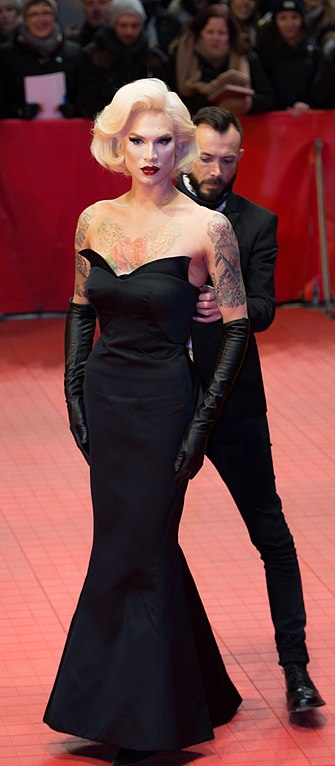 |
| Image: Wikimedia Commons (labeled for re-use) Miss Fame |
It's on my mind to do a series of posts - specifically riffing on drag, though I will try to keep RuPaul's Drag Race references to a minimum - and focusing on the many layers of its making, as well as its cultural position and place(s). While I wonder a little whether this might alienate what audience I have, the point is more to look at the incredible breadth of Doing A Thing - and, in fact, one could write a similar series about just plain being an actor, or firefighter, musician, or visual artist. The discipline tends to be a part of the life of its practitioner, and I want to look at just how much we do in service of results which an awful lot of people might see as a single point in the wide tapestry of life.
Drag happens to touch on the recurrent thematics of this blog - social thought, yes, but also costuming, makeup, a focus on (at least certain particulars of) history, and the multifarious work of entertainment. It can be beautiful and challenging - at its best, and like so much art, it is both at once - and laughter and tears are all but mandatory.
 |
| Image: Wikimedia Commons (labeled for re-use) This is Acid Betty |
And too, like so much of what I write about, I am both an insider and very much NOT so. Subculturally, I've always been accepted even as I think of myself as an outsider, or even a poseur. So drag is one more thing I can appear to write about intelligently, but cannot with integrity claim to be any part of personally. Watching it, even caring deeply about it, being acquainted with those who *do* ... these are not qualifying criteria. So I have knowledge, but not cred.
So stay tuned. The organization is underway, and the thoughts, they are a-thinkin'. Your feedback in any form is always welcome, and I really hope to produce a thing or two of interest, even if the whole series may not be to all my readers' tastes.
Links:
Beauty
Challenge
Costume
Gender
Human
Collection
Every now and then, Blogger stats provide an interesting rabbit hole, or at least a blast from the past. Today, I happened upon this referral link. This makes me smile bittersweet smiles - firstly, because I have not seen The Lady Herself in far, far too long. But also because she talks of our writing group, and a particular story prompt which has never left my brain. The story is above 3500 words, but I've never found a finish - though its ghost has teased me more than once over the years.
This is why my main/long-form writing is historicals. It's never so hard to find an ending! (Just titles.)
Yes, Donna, I am thinking of the conversation we had, where you have no problems with titles and I take years to find them!
It's not a short read, but it's *splendid* writing. As all the best writing is, it's open, intelligent, and honest in viewing shortcomings from the inside ... as well as the margins. Because those who were once in are out, in many ways, and no single outlook can be said to typify perhaps any label anymore.
OH NO, NOT MORE TBR. Both the paean and the lament of any reader, the song of More Yummy Delicious BOOKS. I must-must-must have After the Death of Ellen Keldberg, not least because it sounds like an awfully good book, but also because the cover is a grabber, and at the link above you will find some thoughts on its design. By way of The Caustic Cover Critic. "Enjoy the crocuses." Excellent advice.
Am I the only person who enjoys the heck out of a good scholarly argument? I choose "argument" over "debate" because one of the joys of This Theory versus That Theory is witnessing how partisan participants can be (and indulging the luxury of not having any interest in either side, thus being open to many arguments). Here we have a great example of the genre, in anthropology. Archaeological/anthropological arguments often provide the best enjoyment, because these disciplines after all tell the story of humanity, and we certainly do like talking about ourselves. This sort of thing, for me at least, provides great exercise in critical thinking, which happens to be one of my favorite things. And this particular argument, centering on a volcanic winter, touches on phenomena which actually come into play in my own WIP, wherein the plagues and climatic changes post-535 AD loom large in the plot. I don't actually, necessarily, fully buy into the Catastrophe theory. But it sure makes a good story.
This is why my main/long-form writing is historicals. It's never so hard to find an ending! (Just titles.)
Yes, Donna, I am thinking of the conversation we had, where you have no problems with titles and I take years to find them!
(T)he legitimation of cruelty, prejudice, falsehood, and corruption is the kind of thing, one would think, that religious people were born to oppose, not bless.
It's not a short read, but it's *splendid* writing. As all the best writing is, it's open, intelligent, and honest in viewing shortcomings from the inside ... as well as the margins. Because those who were once in are out, in many ways, and no single outlook can be said to typify perhaps any label anymore.
OH NO, NOT MORE TBR. Both the paean and the lament of any reader, the song of More Yummy Delicious BOOKS. I must-must-must have After the Death of Ellen Keldberg, not least because it sounds like an awfully good book, but also because the cover is a grabber, and at the link above you will find some thoughts on its design. By way of The Caustic Cover Critic. "Enjoy the crocuses." Excellent advice.
Am I the only person who enjoys the heck out of a good scholarly argument? I choose "argument" over "debate" because one of the joys of This Theory versus That Theory is witnessing how partisan participants can be (and indulging the luxury of not having any interest in either side, thus being open to many arguments). Here we have a great example of the genre, in anthropology. Archaeological/anthropological arguments often provide the best enjoyment, because these disciplines after all tell the story of humanity, and we certainly do like talking about ourselves. This sort of thing, for me at least, provides great exercise in critical thinking, which happens to be one of my favorite things. And this particular argument, centering on a volcanic winter, touches on phenomena which actually come into play in my own WIP, wherein the plagues and climatic changes post-535 AD loom large in the plot. I don't actually, necessarily, fully buy into the Catastrophe theory. But it sure makes a good story.
Tuesday, January 23, 2018
When I'm not reading, I'm not writing
There was a period of about two years, when I began seriously writing The Ax and the Vase, that I was not reading for leisure. Research absorbed me in a very special way, I read the work itself, I talked about it a great deal. And I've always read a great deal online. But sitting down with an unrelated novel in my hands, taking an evening or a whole DAY ... I didn't do that. My enthusiasm was all for my own work in progress. Maybe I feared reading other people's writing, even on different subjects, would influence - maybe even compromise - my own voice or story.
Some of this, I think, is new-writer superstition, or more charitably, maybe it was just a different process. There is this, either way: I can TELL you the day I read again for the first time just for myself. What the weather was, what time, where I was, what the novel was. (The Dogs of Babel, by Carolyn Parkhurst.)
My (counter)point is probably a matter of course for most writers: if we are not reading, we are not writing. Say it with me now: "Duuuhh!"
I have not been reading. "There was family visiting" ... "I've been occupied for months with two big meetings" ... "My stepfather's been failing" ... "Holidays" ... it's all the usual load of dingoes' kidneys. The more insidious truth is that I have not been ALLOWING myself to read. I think, ultimately - never knowing why, probably - that was why I didn't read for those two years, back when. I felt like reading was a luxury, or an adultery against my own work.
What we all know is, of course, to BE a writer, you have to be a reader - and suspending that is painful to the process.
So is viewing *writing* as a luxury, as an adultery to the life you're living.
Today, I stopped work and read at my desk. For a few months now, I've been avoiding this; working through, doing other things. Generally acting like That Guy, like what I do is so important it must never be paused - at work and in real life too. In my family, I'm behaving like my stopping to read on my own time may be disrespectful to the difficulty my mom is up against as a fulltime caregiver. At the office, I've had occasion for some guilt nobody has put on me, and I'm overcompensating for acts committed that I know perfectly well nobody holds as sins.
And so, today ... sitting down with just a few pages of LeGuin's Orsinian Tales ...
Ahhhhh. Not merely a luxury, not merely the indulgence of cheating on my job or even my own writing. It was - of course it was - inspiration.
And I found a scene in my throat, urgent as pain, which at first I thought might be a letter to Mr. X, and then I found ... was a scene a certain character really needed. Two of them, in fact. And I learned a little something new about one of the most important events in my WIP. And I learned how to feel from inside a man's skin, for this particular moment. And I saw what it meant, ultimately and really *meant* for the woman he's feeling for, for years and years and long after he is gone from her.
The scene, oddly enough, is all about something incomplete, something un-built; a whole, sought.
It doesn't work out, in the novel. No building, no completion.
But it worked its way out of my brain. No small thanks (eternally, consistently, recurringly) to Ursula LeGuin.
And sometimes, putting a brick against a brick, you end up with a building.
Sometimes.
Some of this, I think, is new-writer superstition, or more charitably, maybe it was just a different process. There is this, either way: I can TELL you the day I read again for the first time just for myself. What the weather was, what time, where I was, what the novel was. (The Dogs of Babel, by Carolyn Parkhurst.)
My (counter)point is probably a matter of course for most writers: if we are not reading, we are not writing. Say it with me now: "Duuuhh!"
I have not been reading. "There was family visiting" ... "I've been occupied for months with two big meetings" ... "My stepfather's been failing" ... "Holidays" ... it's all the usual load of dingoes' kidneys. The more insidious truth is that I have not been ALLOWING myself to read. I think, ultimately - never knowing why, probably - that was why I didn't read for those two years, back when. I felt like reading was a luxury, or an adultery against my own work.
What we all know is, of course, to BE a writer, you have to be a reader - and suspending that is painful to the process.
So is viewing *writing* as a luxury, as an adultery to the life you're living.
Today, I stopped work and read at my desk. For a few months now, I've been avoiding this; working through, doing other things. Generally acting like That Guy, like what I do is so important it must never be paused - at work and in real life too. In my family, I'm behaving like my stopping to read on my own time may be disrespectful to the difficulty my mom is up against as a fulltime caregiver. At the office, I've had occasion for some guilt nobody has put on me, and I'm overcompensating for acts committed that I know perfectly well nobody holds as sins.
And so, today ... sitting down with just a few pages of LeGuin's Orsinian Tales ...
Ahhhhh. Not merely a luxury, not merely the indulgence of cheating on my job or even my own writing. It was - of course it was - inspiration.
And I found a scene in my throat, urgent as pain, which at first I thought might be a letter to Mr. X, and then I found ... was a scene a certain character really needed. Two of them, in fact. And I learned a little something new about one of the most important events in my WIP. And I learned how to feel from inside a man's skin, for this particular moment. And I saw what it meant, ultimately and really *meant* for the woman he's feeling for, for years and years and long after he is gone from her.
The scene, oddly enough, is all about something incomplete, something un-built; a whole, sought.
It doesn't work out, in the novel. No building, no completion.
But it worked its way out of my brain. No small thanks (eternally, consistently, recurringly) to Ursula LeGuin.
“Incomplete. It’s like building something. Unfinished.
And sometimes, putting a brick against a brick, you end up with a building.
Sometimes.
Wednesday, December 13, 2017
Collection
Have you ever found yourself feeling a kind of ... distrust, when you find out someone isn't a reader? Or special admiration, even a crush, on a writer? Even the smallest phrases can be great storytelling; I am able to clearly remember some of the things that have swept my heart away: Beloved Ex's calling me a wonderful bag of things. Humorous, sure. But ... "telling" in a way that was important to me. A girl who once said to me, I have a voice like rain and brownies baking. The friend who called me a flower-eyed waterfall. And Mr. X ... that time he said to me, "You use your wit and intelligence as if your appearance had no power, and the effect is devastating."
Why the self-aggrandizing intro, today? Well, READ on, my friends. On the evolution of storytelling. It keeps humanity alive, literally. And the best storytellers get the greatest rewards, in egalitarian communities. Hmm.
And now, a little consumer culture ...
Of all the people I have known in the 25-year SUV trend, I am aware of ONE who ever used their winch, and none who ever went offroading, or even camping. (In the 1970s, my cousins did have a proto-SUV, but they skiied and camped and hunted and used its immense capacity in full, though not every single time they drove it.) SUVs looked to my contrarian eyes like a Baby Boomer/yuppie fad from the start, and what rugged behavior I ever *have* seen with them seems to be confined to drivers imagining that "SUV" confers upon them not merely invulnerability but also immunity to the existence of others on the roads when it is snowy and/or icy. (Strangely, this does not appy to rain; everyone in this whole town seems to just *crawl* when there is rain, mist, or drizzle anywhere in a 50-mile radius. No matter what they drive.) Anyway, to the link, Batman: on SUVs, and the developing social structure in America, over the past 30 years. As always, there is room for quibbling here. But it's an interesting wider look at "trends" ...
The older I get, the more I LOVE investigative journalism. Doesn't matter when it's a couple or few years old; the detective stories hold up, and truly good writing never goes out of date. Here's a great piece about discovering provenance, and for my writer friends, stay tuned to the end - the bit about publishing a book is priceless.
Here is a joyous(-ish ...) stocking stuffer for you all! More demented cover fails with the Caustic Cover Critic, guesting over at the Australian Book Designers Association. Featuring: Jane AusTIN and Slash. You know you wanna click!
Wednesday, October 25, 2017
Take the Con 17
Two weeks ago, I was in Savannah for work. On Thursday, the 12th, I was home before midnight with nearly a thousand miles on my car ... and Saturday the 14th kicked off the annual James River Writers conference.
In the past, I've often done postmorten posts about how inspired I was and re-energized as a writer, after the conference. Well, or just gushed in real time about how amazing the events are. In the fifteen years of JRW's excellence, I've attended for fourteen of the annual conferences. (Thanks again, Mojourner!) I've watched friends chair the event itself, and met countless others. It's always inspiring.
But this year, I was so focused for so long on the meeting immediately preceding the Conference, I spared no time to get excited about it. (I was actually excited about the meeting - there was toy shopping.) For a while there, I also wasn't sure I'd be able to go to the Conference this year at all, and studiously tamped down any thinking about it.
Not only did I coordinate the meeting in Savannah, but I presented there. Speaking up in class, as it were, has never scared me - but speaking before the class was nerve-wracking. And once my nerves got bored, I finished off okay, and it was okay. I handed out little dart boards with my picture on them to people to whom it is generally my job to give bad news. I got to know a lot of people I work with constantly, but rarely or never have seen before. Feedback has been that the meeting was good. Travel was too (no flying!). I spent Friday in a dim drizzle with my mom, coming down off the big event, and NOT really thinking about or getting ready for the next one.
Coming into the Conference without expectations can be a good thing. I've long since put The Ax and the Vase to bed, and the WIP isn't even advanced enough to have announced to me what its TITLE is, so meeting with agents was off my list (and, in any case, I'm ever more persuaded by Janet Reid's objection to conference pitches - and, in any case, it's rarely the case participating agents even "do my genre" as it were).
The rub is, it's also been a long time since I spent time writing.
So I attended the "so you think you're an impostor - no you're not" session ... and, of course, came away feeling all validated but still knowing for sure I am an impostor.
And I spent $72 at the JRW Bookstore before 8:30 a.m. on day one.
And I talked to my new friend Sarah a lot, a writer who is eighteen years old and better organized (and more motivated) than I am, at damn near fifty.
And I spend time with my good writing friends, and Leila Gaskin said she would read some scenes for me and look to the knotty problem of whether I need all my characters ... and, if so (oh, I so need my characters!!!!), how to balance them ...
... and I finished the weekend more excited about the fact that the Festival of India had coincided with our event than about the Conference.
It was when I began drafting my email to Leila, and my very first writing partner, The Elfin One, and choosing scenes to share toward that question of characters and balance ...
... that it finally happened.
My ass was in the chair, and I sent off the scenes dutifully - and, writing to TEO in particular about writing ... I wrote.
"Also, I'm a Writer."
ANNOYING Flash Fic
The ghouls, the freaks, the impersonators ... they are everywhere!
Every day, we're assaulted with clickbait, dressed up as headlines. For those of us grown wary, they words call attention to their true calling as propaganda ... but apparently enough people are still beguiled by them that the things still exist, and proliferate ...
So, far from being the monstrosities *I* see, the must be really great words. Right?
How about some scary Hallowe'en flash fiction?
Here are the prompt words (and do you think Janet would mind if I borrowed her rules?):
I'll post mine if you'll post yours!!
But YOU will win the wild acclaim of the masses. As for this prize, I recuse myself from eligibility. Not least out of the spine-tingling fear Colin Smith or John Davis Frain might post a story in the comments ... !!!
****
I am NOT afraid of spiders. Prettiest creature of the Hallowe'en season. Any season.
Pretty little liars.
They're just jealous. It’s the *witches’* holiday, and that’s me.
Remembering the seven-footer, an insanely huge web from the kitchen window to the stoop railing. Remember the filament I all but ate last night. The air was finally chilling, walking the dog, one tenacious string, stretched across the sidewalk. Never revealed, it just hit me in the lip.
I am not afraid of spiders. They’re afraid of me.
I do my own weaving. That filament was Arachne’s last insult.
This one trick …
 |
| Image: pxhere.com free images |
Every day, we're assaulted with clickbait, dressed up as headlines. For those of us grown wary, they words call attention to their true calling as propaganda ... but apparently enough people are still beguiled by them that the things still exist, and proliferate ...
So, far from being the monstrosities *I* see, the must be really great words. Right?
How about some scary Hallowe'en flash fiction?
Here are the prompt words (and do you think Janet would mind if I borrowed her rules?):
- Insane
- Chilling
- Revealed
- Creature
- This one thing/this one trick
I'll post mine if you'll post yours!!
But YOU will win the wild acclaim of the masses. As for this prize, I recuse myself from eligibility. Not least out of the spine-tingling fear Colin Smith or John Davis Frain might post a story in the comments ... !!!
****
I am NOT afraid of spiders. Prettiest creature of the Hallowe'en season. Any season.
Pretty little liars.
They're just jealous. It’s the *witches’* holiday, and that’s me.
Remembering the seven-footer, an insanely huge web from the kitchen window to the stoop railing. Remember the filament I all but ate last night. The air was finally chilling, walking the dog, one tenacious string, stretched across the sidewalk. Never revealed, it just hit me in the lip.
I am not afraid of spiders. They’re afraid of me.
I do my own weaving. That filament was Arachne’s last insult.
This one trick …
Thursday, April 27, 2017
Frisson
Something happened with the WIP today. Well, I should say, something happened with me - with my philosophy, my spirit, my self. And I turned to the WIP, and put several plug-ins to prompt myself to the theme, in different places.
Something happened with my writing.
How was your Thursday?
Something happened with my writing.
How was your Thursday?
Monday, April 3, 2017
Writerly
The WIP, currently being called Generations of Sunset, though this perhaps doesn't even qualify as a "working" title since it doesn't (*), is in fact still a thing.
I haven't had much to say about it of late, being distracted by such epochal life changes as a haircut, getting some cabinets for my kitchen, a sick puppy (who is fine now, she just gets an upset stomach now and then), a tiny travel plan or two, and the joy of watching someone I care about a lot falling for someone new. But I do still play around with WRITING.
For my writer pals who stop in here sometimes, I have a question. Have any of you ever given a character some trait that suits your purposes, more than necessarily follows reality?
I'm writing in a period when life expectancies were not what they are today. In The Ax and the Vase, the historical character Bishop Remigius of Rheims was extremely long-lived indeed, but this was true of the actual man, and indeed I used that longevity to speak to his charisma; that he was so venerable marked his holiness for the other characters. In GoS, though, I have a serving woman living a very long life.
It was perhaps easier for anyone, servitor or queen, to get in an extra decade or three, living at a royal court, as opposed to squalor or slavery outside of a palace.
Some people did of course live past thirty-five, even in the "Dark Ages" (well, or just before them). What I am doing, stretching this character across generations, isn't exactly fantasy. But the character's life is directly tied to my need of her presence in every place, at every birth, even through the deaths, through her time.
I don't ask other authors whether they've done this in order to get approval, but out of curiosity. Zeniv has to live a very long time because she is not merely important, but she views the coming of new generations, and is part of the setting, the changing world. She is one pair of eyes witnessing what may be a death (the dynasty of Theodoric the Great) or a birth (a new age, what we came to call the Dark Ages), or may just be the world as it is.
This doesn't quite rise - or sink - to the question of ethics in writerly choices, but I am curious about choices like this that other writers make.
Has any of you ever stretched the parameters of your setting, of history, or usual expectations to accommodate your needs for the story? How?
* As with so many things I think to be clever, the title is a bit of a pun. For many of us, sunset marks an ending - it is the end of the day. But we forget, that is only one way to look at things. Sunset is the beginning of the next day; your dreams are not a closing out of the day past, but the first thing in your mind before you wake to a new day.
Wednesday, February 8, 2017
Collection
At NPR online, Margaret Atwood discusses the next big form. I know from the moment the election was decided, MANY writers were vocal online and everywhere else about how they were already inspired to new dystopian work. To look at the form those works may take is a great exercise; and I think she may be right. The pace of traditional fiction cannot do justice to the creative juices flowing right now.
The evidence from Pech IV and Roc de Marsal clearly shows that the Neanderthals at these sites lived without fire not only for long periods but also during the coldest periods.
The Atlantic has a cool look at fire (hah). I've always been fascinated by the concept of the human hearth; hearth rights, the earliest human domesticity, the social contracts born of our control of and sharing of flame for warmth, protection, and cooking.
TA also has a wonderful link for writers (and readers!), just with its opener (well, or Faulkner's) on this article about asking the right questions. I have talked about the problems I have with creating tension on the page; as a writer of historicals set in known events and amongst characters who actually lived, it's too easy for me to think the (hi)story itself is enough. But it's necessary to know both WHY anyone else would find that enough, and to entice them to want to know. What gifts do we as authors bring to our characters ... ?
Which gets me thinking about my WIP's first line ...
Now, the CLOSING sentence (currently) is a literary in-joke. I love it, though it may not survive. It's worth reading the whole to get to it. Let's hope I'm getting the hang of this tension thing ...
(Confidential to my nerd readers: anyone else watch Caprica?)
Yeah, and it's a lot from The Atlantic today, but bear with me; they have some excellent writing!
Who else recalls Mike Mulligan and The Little House? Staples of my own childhood, I was thinking of the beautiful art for The Little House just a couple of days ago; the way it depicted time, especially; the way the house had a face, filled with emotion. This essay picks up those memories, and finds the relevance right now, with a powerful punch at the whole idea that innovation was invented recently. Y'all know how I love a good recency illusion and a The Dirty, Stupid Past refutation! (Want to get away from The Atlantic? Worth a click is the New Yorker story about Virginia Lee Burton.)
Okay, back to The Atlantic, for another of my obsessions, hygeine! On the industry, social and cultural implications, and pain of feminine hair removal. Evolutionary racism, and Darwin's culpability. Ow.
When a question is asked perfectly, it doesn’t need a tidy answer.
TA also has a wonderful link for writers (and readers!), just with its opener (well, or Faulkner's) on this article about asking the right questions. I have talked about the problems I have with creating tension on the page; as a writer of historicals set in known events and amongst characters who actually lived, it's too easy for me to think the (hi)story itself is enough. But it's necessary to know both WHY anyone else would find that enough, and to entice them to want to know. What gifts do we as authors bring to our characters ... ?
Which gets me thinking about my WIP's first line ...
The heat had begun to feed upon the red tile roofs of Ravenna, as if with a hostile will, when Amalasuntha was born more than eight days late.
Now, the CLOSING sentence (currently) is a literary in-joke. I love it, though it may not survive. It's worth reading the whole to get to it. Let's hope I'm getting the hang of this tension thing ...
(Confidential to my nerd readers: anyone else watch Caprica?)
Yeah, and it's a lot from The Atlantic today, but bear with me; they have some excellent writing!
Who else recalls Mike Mulligan and The Little House? Staples of my own childhood, I was thinking of the beautiful art for The Little House just a couple of days ago; the way it depicted time, especially; the way the house had a face, filled with emotion. This essay picks up those memories, and finds the relevance right now, with a powerful punch at the whole idea that innovation was invented recently. Y'all know how I love a good recency illusion and a The Dirty, Stupid Past refutation! (Want to get away from The Atlantic? Worth a click is the New Yorker story about Virginia Lee Burton.)
(S)uccessful in eliminating hair, and also in causing muscular atrophy, blindness, limb damage, and death.
Hoo baby!
Okay, back to The Atlantic, for another of my obsessions, hygeine! On the industry, social and cultural implications, and pain of feminine hair removal. Evolutionary racism, and Darwin's culpability. Ow.
Wednesday, November 16, 2016
Tesserae - or - In Democracy, You Don't Necessarily Have to Rewrite History ...
 |
| Image: Wikipedia (detail) |
One of the reasons I love research is that, if you do it right, sometimes you learn a little bit more than "and then the Catholics enacted damnatio memoriae on Theodoric the Great, because he was Arian Christian."
In Ravenna, Italy, where Theodoric ruled and where most of my WIP takes place, is the Basilica of Sant'Apollinare Nuovo. Dedicated in 504 to Christ the Redeemer, it was his palace chapel. Theodoric subscribed to an early sect of Christianity known as Arianism, a non-trinitarian faith which was at the time of Theodoric and Clovis losing ground rapidly to a smaller, more obscure sect known as Catholicism.
After The Great King's death in 526, several political and religious (and yeah, same thing in many ways) forces combined to produce incalculable unexpected results.
Theodoric, who had spent his youth as a court hostage in Constantinople - honored, cared for, and almost undoubtedly educated by his captors, very definitely in favor with them and well liked by them - was rewritten by his own Ostrogothic nobility as an illiterate Barbarian. This picture of Theodoric the Great holds to this day in the popular imagination (so far as he's popularly remembered at all). Yet a cursory look at his career speaks to a different conclusion.
Also upon his death, the Catholic upsurge in Ravenna, Theodoric's seat as King of Italy, led to certain redecoration.
Look at the image above in another window, zoom a bit, let its details come clear. You will see a couple of disembodied hands.
The Church, taking over Christ the Redeemer when the king's palace chapel became the Catholic's basilica, made some edits to its mosaics and thematic decoration.
Theodoric's family were once framed in each arch showing in the mosaic above. His daughter, Amalasuntha, was one of the figures. Amalasuntha was one of those rare princesses who became a regnant queen - for a while. Theodoric had no sons, and she was his only legitimate offspring. Thus to her fell the responsibility for bearing a royal heir, which she did, but not to great effect. King Athalaric inherited as a child, apparently became dissolute in his youth, and died still under the regency of his mother.
Because I am a lying liar who lies ("writer"), at this point in drafting the manuscript (always note: with a WIP, anything I say and/or write is subject to change), the Catholic takeover of Redeemer, and their ascendancy, are accelerated a little. Not by multiple generations, but I pulled up the most likely time of their reconsecration of Redeemer, specifically, by roughly twenty-four years. Generally thought to have occurred in AD 560, I have it happening within about a decade of Theodoric's death.
The reason I pulled this piece of history into my historical fiction was to play parallels with the Ostrogoths' revisionist history of the Great King and the Catholics' damnatio memoriae of his dynasty, brief though that was.
The most striking thing about the latter events, in the symbol of those mosaics above, is the disembodied hands.
Imagine being the survivor of a dynasty that only survived three generations, looking up at the church your grandfather built, looking for the images of your family, your brother, your mother - and seeing only their maimed fingers or hands.
Irresistible scene, of course. I had to envision that.
But the reason those hands are most interesting is not the absence of everything else. It is their presence.
I've used the phrase damnatio memoriae - and, for the Romans and many other cultures throughout the world and through human history, destroying someone's name, removing them from the history books as it were, was a powerful tool. To be sure, we still remember those whose names have been stricken out. But that's not the point of a DM, not really.
The point of striking out a name is not to pretend "so and so never existed" ... but to point TO their existence, and to highlight the obliteration of anything so and so ever accomplished.
The disembodied hands are not an error, an incomplete obscurement of a vanquished opponent.
They are the reminder of the vanquishing.
We have erased something here, the images said. We have the power to remove—but we want to remind those we have supplanted.Damnatio memoriae was no obliteration. It was a reminder. This has been done, and we have undone.
--excerpt from the WIP
Possibly the deepest root of my patriotism lies in the pride I feel not only in voting, but in witnessing the peaceful transfer of power in the United States. I've participated for 30 years now as an active citizen, and watched this process for about forty-five. I remember Jimmy Carter's election, Reagan's - I remember Watergate, and the echoing word, "impeachment."
I remember the giddy sensation of watching the 2000 election, the fear then, the outrage. I don't expect to forget 2016 without illegal amounts of chemical intervention or outright dementia, neither of which appeals.
The new administration will do some amount of damnatio memoriae as it finds its way. ACA is on the block; many people's futures seem to be as well.
The American DM will not be a revision of history, it will be a change of what is envisioned.
Saturday, November 12, 2016
This Week
This week, I've seen those who are horrified at the United States' election outcome galvanized, all but instantly.
I'm not one of those people.
That first reaction I had, of gritting my teeth and practicing gratitude, didn't come easily, but it came unbidden. It was unexpected. I might have expected anger (I do have anger, but it is secondary with me), but perhaps I was too tired, too shocked. And anger is not my go-to. So gratitude and determination are not natural to me, but outrage apparently is less so. So.
The comments section at Janet Reid's blog is not a homogeneous slice of like-mindedness. The "Reiders" (I came up with that name thinking it was a bit on the nose, but it seems to have stuck) don't like the same things, we don't do the same things, but the people there - those who comment, and the many who read and seldom speak or never do - comprise a community.
The conversation there has always been one place I recommend as the one place on the internet you can - and *should* - read the comments.
This week, it has been one of the few places into media/social media/Teh Intarwebs I have not been afraid to go. It was impossible for me to listen to punditry or analysis of any kind. Until today, the actual physical pain of what has been done has been too much; being alone at night has been devastating. (Sometimes, even Gossamer the Editor Cat is not enough.) But the Reiders have been my reminder, COMMUNITY is what we come down to. (Okay, the Reiders and Jeff Sypeck, who commented on that post above with such sensitivity and insight.)
The open communication there - from the silent majority, from those who voted Trump but unhappily, and from the many who have shared something of my own horror, has been intelligent and reasonable. Utterly constructive.
I'm grateful for the Reiders, this week.
Monday's post - memories and hope.
Tuesday's discussion - little post, but so many there to speak.
Wednesday's continued management of the situation - and hope - and such a wave of creative galvanization.
Me, I'm still working through. I haven't really begun to act. I'm cutting some things out of my life - shows that are "edgily" wrong to be funny, and normalizing homophobia (bye-bye, Big Bang Theory) and even racism (Archer). Those that don't even think they're edgy, but propound reductive, retrograde gender roles (any reality TV other than RuPaul's Drag Race) and feminine lack of education/intelligence.
Once I'm less afraid of where the economy is going to go from here (augh), if I have money, I'll put it where my principles are more than I do now.
I will speak.
And, Janet: I will write.
Sunday, November 6, 2016
New Flash
Janet Reid is running another flash fiction contest.
Prompt words:
cat
nose
tail
stare
hello
My entry:
"NOSEDIVE!"
Frantic. "Attitude--flight attitude malfunction! tailspin!"
She'd never seen the controls like this. Stared, time stopped. This was death.
She had trained, she knew what to do. Just over mach 7 when the rocket malfunctioned--now approaching 4. She'd lost less than ten thousand feet and the port aileron. She compensated. She breathed. She held, hard. She compensated again.
The mountains rose up as if to greet the craft. The world twisted, a yaw she had never felt, the roar obliterating all other senses.
The gates were really all pearls.
“Hello …”
Wednesday, August 31, 2016
Time and Chance (Neither Sharon K Penman nor Ecclesiastes)
It is perhaps not the sort of admission a writer should make; but more, I suspect, than would like to admit it may find what I'm about to post familiar ...
The WIP began, as many know, as an inspiration early in the research for The Ax and the Vase. I was fairly successful, during my work on Ax, in keeping the WIP on the backburner - not using it to distract myself from frustrations with the first novel - and not letting it steal me away on its own impetus either.
And so, the WIP has been in gestation for something like thirteen or fourteen years now.
It was brought to the front burner a year and a half ago or so, but this summer I have allowed the demands of work and life and other such silliness as that to keep me from dedicated writing.
Now and then, when we're not really working on them, writers do at least pull OUT our work (or pull it up, as on electronic devices). We look at it, we pat it on its evil/cute little plot-bunnied head, we expect it to speak, and often it fails to. For all works of creative writing have a habit of acting on their own, especially individual characters, running off and doing things we had no idea were in them, creating unexpected continuity issues to resolve - they have an even crueller tendency NOT to do this when we sit and look at them, bereft of active ideas or plans.
WIPs, when you pull them out and expect them to develop themselves, will stare you down like sullen teenagers. Mute, un-forthcoming, inert.
And so, it was a surprise to me, today, when the sullen thing spoke to me.
I pulled it up just now. Peered at it a bit. Scrolled to the end, because I don't really know where it needs to end, or why it seems to end so far beyond where it begins.
I would be hard-pressed, in short, to tell an agent honestly "what is the crisis here, what needs resolving?"
As a historical fiction author, I am inordinately attached to the idea that telling the stories of history itself is important, worthy, fascinating. But where the fascination lies, I seem to be very poor at defining. Why tell it? Um. It's cool. See? Where the king goes Catholic, instead of Arian, and the entire future of Christendom - and Western Europe - is decided? Neat, hm?
Ya gotta have an MDQ. History is great, but a story isn't just the litany events leading from point A to point B, where there's a new chapter or we lose interest.
And I had no idea why my WIP was going on into three generations of women I think are each a study in contrasts, and whose lives deserve to be shared. Three is a great storytelling trope, but why was I going into character #1's mom and daughter, when it was #1 who drew me initially? What has it been, all this time, telling me that mom is necessary, that we can't stop without daughter, that #1 should *not* stand alone ... ?
And what is the title of this thing?
Titles are hard. And hard-won. Authors can be extremely attached to a title, emotionally vulnerable to the idea of changing one. They're harder to write than poems, perhaps. Or they ARE poems, perhaps.
So today, scrolling to the end, and then back to the beginning, when I caught sight of that moment when the character has just opened up our action by giving birth to #1, and she realizes she has not born a son ... one phrase caught my eye.
But; there is no later.
And that was when it clicked.
What I am writing about - and THIS, I have known for a long time, is the events that lead us into that period so many historians used to call (and, gallingly, most of the regular populace still call) The Dark Ages.
I'm writing about dissolution.
I'm writing about the end of a dynasty, not only from the point of view of #1, the child who had the wrong genital equipment, but also from the point of view of #2 - a character more vivid than 1's mother and her daughter - the freedwoman who literally births the END of the dynasty; the midwife who, perhaps, has her hands not only on the labours of her noblewomen, but on the pangs of a new era emerging.
That part came just now, just writing that paragraph. Exciting stuff; bear witness, y'all.
So the working title (and I feel it perhaps bears the wrong tone; so this too may pass) has become, Time for Posterity.
And the question is: how does it end?
How does a dynasty end? How does an era end? How does darkness begin? (Do I even believe there was an age of darkness appropriately to be named The Dark Ages - well, no - but it makes a hell of a story, and it's been sucking at me like a vortex for thirteen years, I realize.)
So, yaaaayyyy!
I'm about to become the AUTHOR of the Dark Ages, and I don't even believe in them!
Neato-spedito, as my brother used to say.
The WIP began, as many know, as an inspiration early in the research for The Ax and the Vase. I was fairly successful, during my work on Ax, in keeping the WIP on the backburner - not using it to distract myself from frustrations with the first novel - and not letting it steal me away on its own impetus either.
And so, the WIP has been in gestation for something like thirteen or fourteen years now.
It was brought to the front burner a year and a half ago or so, but this summer I have allowed the demands of work and life and other such silliness as that to keep me from dedicated writing.
Now and then, when we're not really working on them, writers do at least pull OUT our work (or pull it up, as on electronic devices). We look at it, we pat it on its evil/cute little plot-bunnied head, we expect it to speak, and often it fails to. For all works of creative writing have a habit of acting on their own, especially individual characters, running off and doing things we had no idea were in them, creating unexpected continuity issues to resolve - they have an even crueller tendency NOT to do this when we sit and look at them, bereft of active ideas or plans.
WIPs, when you pull them out and expect them to develop themselves, will stare you down like sullen teenagers. Mute, un-forthcoming, inert.
And so, it was a surprise to me, today, when the sullen thing spoke to me.
I pulled it up just now. Peered at it a bit. Scrolled to the end, because I don't really know where it needs to end, or why it seems to end so far beyond where it begins.
I would be hard-pressed, in short, to tell an agent honestly "what is the crisis here, what needs resolving?"
As a historical fiction author, I am inordinately attached to the idea that telling the stories of history itself is important, worthy, fascinating. But where the fascination lies, I seem to be very poor at defining. Why tell it? Um. It's cool. See? Where the king goes Catholic, instead of Arian, and the entire future of Christendom - and Western Europe - is decided? Neat, hm?
Ya gotta have an MDQ. History is great, but a story isn't just the litany events leading from point A to point B, where there's a new chapter or we lose interest.
And I had no idea why my WIP was going on into three generations of women I think are each a study in contrasts, and whose lives deserve to be shared. Three is a great storytelling trope, but why was I going into character #1's mom and daughter, when it was #1 who drew me initially? What has it been, all this time, telling me that mom is necessary, that we can't stop without daughter, that #1 should *not* stand alone ... ?
And what is the title of this thing?
Titles are hard. And hard-won. Authors can be extremely attached to a title, emotionally vulnerable to the idea of changing one. They're harder to write than poems, perhaps. Or they ARE poems, perhaps.
So today, scrolling to the end, and then back to the beginning, when I caught sight of that moment when the character has just opened up our action by giving birth to #1, and she realizes she has not born a son ... one phrase caught my eye.
Time for posterity later.
But; there is no later.
And that was when it clicked.
What I am writing about - and THIS, I have known for a long time, is the events that lead us into that period so many historians used to call (and, gallingly, most of the regular populace still call) The Dark Ages.
I'm writing about dissolution.
I'm writing about the end of a dynasty, not only from the point of view of #1, the child who had the wrong genital equipment, but also from the point of view of #2 - a character more vivid than 1's mother and her daughter - the freedwoman who literally births the END of the dynasty; the midwife who, perhaps, has her hands not only on the labours of her noblewomen, but on the pangs of a new era emerging.
That part came just now, just writing that paragraph. Exciting stuff; bear witness, y'all.
So the working title (and I feel it perhaps bears the wrong tone; so this too may pass) has become, Time for Posterity.
And the question is: how does it end?
How does a dynasty end? How does an era end? How does darkness begin? (Do I even believe there was an age of darkness appropriately to be named The Dark Ages - well, no - but it makes a hell of a story, and it's been sucking at me like a vortex for thirteen years, I realize.)
So, yaaaayyyy!
I'm about to become the AUTHOR of the Dark Ages, and I don't even believe in them!
Neato-spedito, as my brother used to say.
Friday, May 27, 2016
Scent of Bread and Onions
... today's headline comes from the moment I stepped through the door from my side of the office building, and emerged into our atrium, where the fragrances of lunch open your nose.
The phrase kind of takes you places, doesn't it? I like the shape and feel of it. It might need a The. It might not. I can imagine places it might take us.
Wouldn't it make a great title?
Wouldn't it make ... a great prompt for flash fiction?
I'd love it if you agreed - and decided to take us places, in the comments.
Subscribe to:
Posts (Atom)