Showing posts with label history's mysteries. Show all posts

Tuesday, August 11, 2020

What DID happen to them?


This is one of my favorite videos in a long time. 24 minutes and some change, but if you're interested in dogs and history, or the history of dogs, worth every bit of it. Carolinas of course do feature, and in this context pups like my girl are even more interesting.

Wednesday, November 22, 2017

Collection

Turn of the century Worcester Mass in pristine portraiture by William Bullard - not only a great record of people of color living there around the turn of the 20th century, but a pretty remarkable testament to photography itself at that stage (some of the images are stunning in detail and clarity) and a trove for history or costume enthusiasts. Certainly a wonderful sort of neighborhood genealogy; the detail regarding who is who is stellar. (You can exit the slide show for a bit of background, but I'd recommend NOT scrolling down to the comments section. Just enjoy Mary E. Price's glorious traveling ensemble, Edward Perkins' garden, or the many joy-inducing kids' portraits.)

When we were freaking out about Trump's election a year ago, my brother and I clung to certain things. Awareness that we were less likely to suffer, and still have more power by way of this privilege, than others ... the ignorance we still had to some extent back then (though little faith in that famous "pivot" they used to go on about, even as they prognosticated Ivanka would save us all). And infrastructure. Trump's dedication to infrastructure looked GOOD, so we invested in the idea of his investments there. He's a real estate guy, it was something to get behind, right?

Well, if this has anything to do with his administration, hope may yet have reason to spring eternal. And this click isn't even political at all, actually! Go forth, if only because architecture is pretty durn cool, and apparently can be made to smell really good, too. Mmm, Douglas fir. 'Tis the season!

The click beyond: NOVA's recent look at the earthquake-readiness of China's Forbidden City. Engineering is extraordinary, but replica "re-enactment" experiments are the stone cold bomb diggety!

Dr. Art Evans, entomologist, is a regular part of my evening commute. And a favorite part!  This week, he did a segment on an internet CREATURE sensation. The clickbait vibe reminded me of the keywords I chose for this (failed :() flash fic post at Hallowe'en.

The historian Henry Adams was being metaphorical, not medical, when he described power as “a sort of tumor that ends by killing the victim’s sympathies.”

The Atlantic looks at the brain science studying the debilitating effects of power. Per Spock: "Fascinating!" He must've had a toe holder ... or all of Vulcan culture was a toe holder ... !

Also fascinating, but in more of a car-wreck kind of way, is the second time this week I have witnessed The Atlantic using the term GALS and mentioning a "lady problem" in a political piece. The byline is a woman writer, and it seems apparent that this is a gendered sort of informality - because, you know, girlies talk like that. Either that, or you can't expect journalistic standards out of GALS.

In my entire life, I have never known a friend or coworker to use this term except in sarcasm. Most often, it's been a comedic prop, this word. See also: 'lady' - which is a queasy joke for a lot of us in my generation, because it is so often wielded by oily guys who think they have a way with The Ladies.

These words are diminutizations. They're inappropriate to a serious piece looking at an important dynamic, and they chip away at the very power of the feminine vote by subtly dismissing it using joking terms. It also erodes the influence of reportage which has set a certain standard of reliability, and negates an article which clearly involved a lot of research and legwork - there are interviews, there are stats and links and sources. There are conclusions, too. And there are "gals" and a "lady problem" (not in quotes used in the article, but in the writing of the reporter herself).

Thursday, February 16, 2017

Eddies (Not in the Space-Time Continuum)

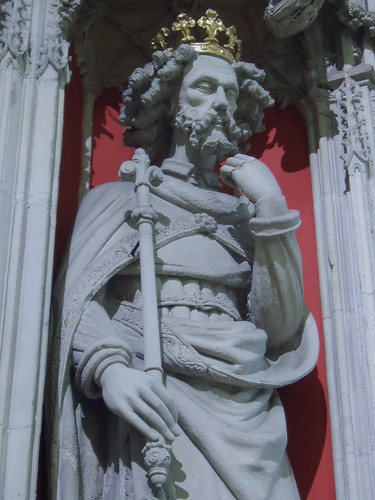
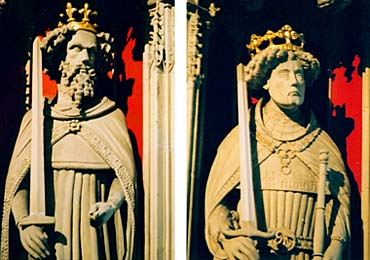
York Minster is home to a series of statues that have always arrested me outright. The effect on me is mostly with the earliest Edwards post-Conquest, we have Longshanks (I), Edward II, and III. Each of these portrait sculptures has always seemed to me among the most animated statuary I have ever seen. But there is something about the style of the art that demands questioning and study, and is for me an illumination of the reason we study art from bygone periods.

Longshanks in particular has an imperiousness that is powerful in the extreme. Pointing down at you, his forehead creased with the stress of some imperative or command, even his curling hair alive with motion and unspoken intent, his vertical stretch, his heavy but moving robes, everything about him (not least a weighty sword he carries as if it were a feather) demands not only attention but acquiescence.

Image: Wikimedia Commons


The thing about the fact these were done centuries before my generation came to be (or indeed my country, for that matter) is that there are conventions in place in the creation of these images that I almost certainly do not understand.

A modern American, the very concept of autocratic kingship is a toughie.

Edward II, whose reputation has been reduced to his sexuality in modern times, appears less martial, but no less royal. His hair, like his father's and his son's, especially evokes a kind of intensity. I have to believe this is not intended to convey that these Plantagenets had hairstyles quite so specifically reminiscent of Roseanne Roseannadanna (though her intensity stands up next to the kings'!), but speaks to something other than feature-by-feature reproduction.

The portraiture, of course, comes from a single, briefer time frame than the Edwards' reigns; these images are not real time reflections, and would not have been taken as such. Rather, the features both individual and shared communicate something about kings in concept, and each of these kings' legacies in their particulars.

Edward II, not known as The Hammer of the Scots, nor for the long and prosperous rule of his son III, has a thoughtful mien about him. His left hand raised and wrist curving, his right holding NOT a sword. The lines of his height, his garments, are more broken, more complicated. He is belted, and he is draped in multiple directions. His head bows forward ever so slightly, and at a definite angle compared to his father. He appears to be contemplating something. Possibly, his thoughtful thousand-mile gaze could be seen as thought*less*, even stupid, the gesture of his hand equivocal, less strong than the others. What was I meant to see, looking at this figure? I may not see what was intended ...

Edward III, famed for a stupendously long reign, and often seen these days as having remediated some of the perceived sins of his father, looks almost as if he is answering someone. His brow is again furrowed, pressed downward, but his chin pointing upward. His beard is the longest and least curly; the lines of his garments, indicating his body beneath, are again long and straight, but like his father and unlike his grandfather Longshanks, he is belted. Girded. His mantle is thrown over his right shoulder, his arms free; again, he indicates motion. His hair may be the most startling of the three statues.

To III's right, the nearly beardless Richard II stands; the youth, the scion, the one who faced rebellions and a changing monarchy. His cheeks seem the faintest bit chubby. His forehead, his whole face indeed, is smooth and not caught in the extremity of expression of his forbears. His hair is almost horizontal. Richard's statue retains some pigment from its former painted decoration. Like his great-great grandfather, Richard bears a sword, its tip, strangely, lost in that hair. Like Longshanks and his grandfather, III, he is pointing at the viewer. Yet the impression is that we are looking at *youth*, looking at a king whose reign did not reach the maturity Edward III's long stint on the throne held and seasoned for England.

Richard II was the son of Edward the Black Prince, who did not live to ascend the throne. He was a boy-king, like Edward III had been before he overthrew the regency of his mother and her lover, Mortimer. Richard depended upon, and then fell out with, his uncle Lancaster and his cousin, the eventual Henry IV, whose son Henry V is reminding me for some reason of Martin Sheen in this link.

Henry has both hands full, and does not look to his viewers, eyes elevated, sword - we know - ever valiant. Ever more unto the breach, my friends.


Of all these figures, it is the Edwards who seem most alien to me, who arrest my attention. They are frankly ugly to my eyes. Startlingly so. Not as works of art, but as evocations of individuals, as portraits. The intensity is too much, the emphases uncanny.

To view the details of these statues closely, as is possible in photographs, was not the way they were made to be seen. Would have been inconceivable, when these were made. They reside, in physical reality, above the heads of anyone entering York Minster. And, for anyone standing in that consecrated place, it would even now be impossible to look at them with the care that we can in the reproductions and detail shots I have linked. It would in fact have been unseemly, in their day, to expend great attention on statues of kings - "what they looked like" - as a member of a religious congregation. And the multiplicity of these figures would have discouraged that sort of gazing.

The view when they were made did not allow the privilege of peering we have now.


As much particular attention as has been lavished on every one of the statues, the truth of the art was that they were meant to be part of a whole; elevated over the flesh-and-blood parishoners, but as much a part of the congregation gathered before G-d as lesser men. A mass of figures. These were statues glorifying the monarchy, certainly; even telling stories of each king's life and deeds. But they were ultimately part of the glorification of G-d - and the Church.

The potent energy of the Edwards may have been intended as part of a more en masse evocation of the intensity of worship, devotion, praise expected to be offered on this sacred ground.


Anyone who knows more of medieval art than I do - please disabuse me of any of these notions, or explain those aspects of what I am missing. I'd love to talk! These faces make me stop and stare every time.

All I can explain are those things I don't understand within the context of these works' creation - royalty itself; the finer points of Plantagenet politics or history; the specific legends of each of these individuals' reputations ... just how far these amazing portraits are even meant to be seen AS individuals. Allegorical implications. The filter of the history already passed between Longshanks and York Minster's decoration, so many generations later.

Sunday, December 29, 2013

Thursday, May 30, 2013

Look Again: at Jane Seymour

In the strange proportions of the marriages of Henry VIII (Aragon's duration being by far the longest, though in the telling she tends to be dismissed in a hurry in order to get to the blood and sex; and then three wives in quick succession during his final seven years), Jane Seymour's less then two year reign beside the king is often simplified as the quiet after the storm, when a milk-faced cypher meekly made history first by being the greatest love in the life of a man later immortalized as a bloody tyrant, and then by bearing his madly-desired son.  Jane herself has been immortalized for her submissiveness - bound to obey and serve - and for being the one bright flame for a king hurtling viciously through darkness.

But what might Jane have really been - behind the legend ... and if she had survived ... ?

Monday, April 22, 2013

Pitty Penny - the Carolina Dog


Having fallen quite winsomely in love with her yard now that it's fenced in, Penny has begun exhibiting another apparently defining Carolina Dog behavior, the digging of small, shallow holes.  Her features are a giveaway, especially that crook or whiplash tail - but her behavior is telling on her too.  And I think more and more about the implications of her amazing breed.  In fact - she's something more elemental than the mere human-conceived idea of "breed" - she is a dog, unadorned.  She is both beyond my reach in those arbitrary traits humans came to feel it necessary to manipulate - and yet so utterly in synch with me as another species, it's all the more amazing she *wasn't* custom-made to adhere to artificial/practical preferences.

(Perhaps obviously) I'm not one of those people who get wrapped up in breeding.  The particulars of her features aren't deal-breakers for me, and I didn't pick her based on anything she might have "been" in that context.  Finding out was, indeed, a complete accident.

I am, however, the sort of person quite fascinated by the anthropology and genealogy of the relationship between humans and canines - and, very interestingly indeed, Penelope is part of a breed the study of which may be shedding light on the depth into history our relationship goes.  It's possible the dog was domesticated as far back as 100,000 years.  We have thought as little as one *tenth* that time frame might encompass the human-canine bond; the idea it's such an astonishingly long relationship is exciting.  (Plus, the scientist who put forth evidence of this theory, Robert Wayne of UCLA, has a name I happen to like.)  It looks like we have worked with dogs longer than we've worked the earth itself, in the sense of recognizable agriculture.  An intriguing, startling idea.  This is the one factor which could someday contribute to my having Pen genetically tested; though her ancestral provenance seems pretty darn clear indeed.  (Note:  Carolina dogs were not part of Wayne's research; their fascination lies in their history on this continent, and the relationships to dogs on the other side of the land bridge, such as Korea's chindo-kae and the Australian dingo, which got Dr. Brisbin thinking about the American "yaller dog" in the first place.)

Even the breeding patterns of the Carolina are unlike most modern domesticated dogs, and may reflect high frequency and quantity breeding in the wild, and even may reflect the availability of prey in the wild.  The digging of the little pits (supposed to take place only in autumn - which Penelope had to wait for, not having a yard until this spring - and largely characteristic of the female Carolina) has as yet no explanation - but shoot.  Dogs dig.  They can hear and see a thousand things you and I can't; so for us who don't speak puppy so well to figure out their whys and wherefores will take some time.  The Carolina's hunting patterns are unique as well, and I can almost see in Pen's simple mannerisms some of what is described (killing a snake by whip-like movements - she is nothing if not whippy).

Also exciting are the facts of these dogs' survival, so unadulterated, and the geography that has preserved their position at the base of the genetic tree of canine development.  Though their discovery has been somewhat south of my own neck of the woods, there is at least a glancing sense that I came from the same earth she did.  Even if she has been native to it for many millenia longer than my line.  If I serve her well, maybe I can serve my piece of the earth with some responsibility (all the while letting her dig snout-holes in her piece of my piece ...).

All dogs are, of course, part of an age-old line linking us as species - but to think that my little girl is family with the oldest breeds in America is just neat to me.  She's a beauty and a dear, and needs no terms but her own to earn my most sickeningly sincere devotion - but she may also be a part of an eight thousand year American lineage is too much for this history/anthropology/archaeology/DOG nerd to bear without a little more peeking.

One of the things that captures my imagination, about the possibilities (likelihoods) of Pen's breeding, is that her behavior seems to be so typical of what is described in certain aspects (her shyness, her snout-holes, even her barking patterns and ability to bond while still being somehow wild) is that her more general demeanor begins to beg questions in my mind.  Perhaps the most distinctive aspect of her personality is that the fulcrum of all her behavior is based on me.  Her need to please the alpha - and her fundamental recognition of me as such - tempers every action.  She's excitable, to be sure; but, even at her most wriggly and easily distractable, she quite literally, physically looks to me.  She's not always easy to guide, but the speed with which she's come from complete insecurity to a pretty sophisticated role within our little motley pack is dizzying.  The day she first came home, she could have submitted to the cat as easily as to me as her alpha - but today she responds to me physically, verbally, and indeed emotionally.  Her dependence upon me is firm, and she expects my protection and my guidance.  She responds now to signs alone for commands - it has become amazingly easy to get her to sit, down, and even to stay (this last one is the command most easily broken by distractions, but as she grows older I have no doubt she'll get better) and now she is learning the key command of "back."  She obeys in varying contexts, and with either hand I use.

The speculation I go to, off this, is how intense the communication can be.  If we have communicated with animals like her for eight thousand years, and she is a modern manifestation of a breed not much altered by human interference - how old is this communication, this obedience, which is so key to the specie-al relationship between human beings and these amazing companions?  If they have been domesticated since before her own ancient line ever began, how innate is this dynamic?  With her, it seems to be deeply hard-wired.  I've never seen a dog so palpably driven by this guidance.  Penny is brilliantly smart, but there is something beyond intelligence in the imperative between us, it is a balance of such symbiosis as I have literally never encountered before.  I've loved every animal I was ever blessed to live with; everyone here who's read any entry older than this past year knows how deeply I wanted to be *good enough* for Sweet Sid, and how much my cats have all meant to me, in their beautiful and different ways.  Even among bonds such as these, the literal *working* relationship I have with Penelope is something special.  She awes me in a way I haven't experienced - simply because I never worked so hard *myself* to communicate with any other animal.  Not in ways which accomplished such practical outcomes.  My Pen is remarkable even among my remarkable puppy (and kitty) loves.

Fact sheet on Carolina dogs.

Smithsonian Magazine with a brief word on Carolinas.

Nat Geo on the Carolina.

Sunday, April 7, 2013

Getting Naked - Costume Research

Thanks to the Two Nerdy History Girls (their brief commentary on the clip is worth reading), take a look at this 1897 film of a woman undressing.


Though it was intended as titillation (the dark powder poured on the model, to stand in for water, is an interesting approach to special effects), the short is a very clear view of the authentic silhouette of the period, and its components.  Recreations of late Victorian style are generally unrecognizeable in film and television productions; the real layers are almost clunky and awkward (as in the garters running over a bunched-up petticoat).  Certainly not the candlelit silk jacquards and sumptuous skirts under perfect nipped waists and absolutely shaved ... everything ... we often see presented as "historic" costuming today.


As a disclaimer, there is brief footage of the woman entirely nude (no frontal, if that arbitrary distinction is particularly offensive to anyone).  By contemporary standards, it was highly shocking stuff, but the clip today is passable as academic and in no way pornographic.

Saturday, November 24, 2012

Another King Richard ...

... this time, that scoundrel the Lionheart.  While we await the forensic face of what so many of us illogically but fervently hope is the skeletal remains of Richard III, we can also wait on a rather interesting test which may tell us some interesting facts about the death of Richard I.  You can also peek at Nancy Bilyeau's novel about the unusual facts of the famous cour de lion's death - thanks to, of all things, tests on his cour.

Oh yeah - I went to the "key to the heart" place.
(public domain image)